
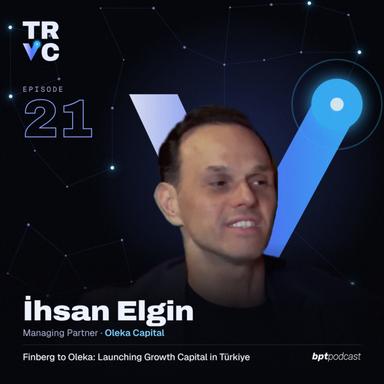
TRVC21: Finberg to Oleka: Why Turkey Needs Growth Capital Now | İhsan Elgin on TRVC
25 Şubat 2026 · 45 dk
PlatformlardaSpotifyApple Podcasts
In this episode of TRVC – The Turkish VC Podcast, Yunus Çelebiler sits down with İhsan Elgin, Managing Director at Finberg and Managing Partner at Oleka Capital, to discuss the evolution of venture capital in Turkey — and why the next phase of the ecosystem will look very different from the last five years.İhsan shares his journey from corporate executive at Koç Group to startup founder (with a U.S. exit), to launching one of Turkey’s first accelerator programs, and ultimately building Finberg into one of the country’s most active venture platforms. He explains how Finberg started as a $5M fintech-focused fund and achieved a 5x return in just 3.5 years — and how that early success shaped its expansion into thematic funds and a fund-of-funds strategy.The conversation then turns to Oleka Capital, a growth-stage investment platform designed to address one of the biggest structural gaps in the Turkish ecosystem: the lack of institutional growth capital with real operating expertise. İhsan outlines Oleka’s approach — combining a core growth fund, SPVs for larger tickets, and venture debt/private credit solutions — to provide “growth financing,” not just capital.Key topics in this episode include:
- Why Turkish startups must expand regionally (GCC, Eastern Europe, CIS)
- How cash returns now matter more than paper valuations
- Why the zero-interest-rate era distorted venture investing
- The coming shakeout among Turkish VC funds
- Founder-friendly vs investor-friendly markets — and why we are entering a more balanced phase
- Capital efficiency, financial discipline, and why unit economics are non-negotiable
- Building value creation plans before investing
- Reverse-engineering exits before writing a check
İhsan also discusses how trust between founders and investors weakened during the boom years — and why rebuilding that trust is essential for the ecosystem’s next chapter.This episode is a deep dive into the structural evolution of Turkish venture capital — less about hype, more about fundamentals.If you are a founder, investor, LP, or operator building in Turkey and the surrounding region, this is a conversation you don’t want to miss.—About TRVC:TRVC (The Turkish VC Podcast) explores venture capital, startups, and technology in Turkey and the broader region. Hosted by Yunus Çelebiler, TRVC features leading founders, investors, and operators shaping the ecosystem.Subscribe for weekly conversations with the people building the future of Turkish tech.
Transkript
Welcome to TRVC - The Turkish VC.
I'm Yunus Çelebiler.
Today, my guest is İhsan Elgin, managing director of FinBerg and also a managing partner at
Oleka Capital.
So both of those organizations, Oleka Capital is fairly new, so it'll be great to hear about.
Welcome, İhsan Bey.
Welcome.
Thank you.
So I'd like to start a little bit with your background and how you got into venture and
interested in in the startup ecosystem sure sure i have started the business life at 2000 and i was
working for the one of the biggest group of turkey which is called coach group as a business
development guy in the energy category so then i did my mba in the mba i took a lecture from the
babson college professor in entrepreneurship it was the first time i heard entrepreneurship
word in my life so after the finishing to the universe mba sorry it was here in it was here
but it was the first years of the Koç University.
That's why all the professors coming from out of Turkey,
just three, four of them coming from INSEAD, Babson,
they were doing a good job that time.
Is it still at the old match factory?
Yeah, it was there.
It was there.
So I'm a little bit old guy.
Fun years, the creation of Koç University was, I think...
It's a really good one.
It's a really good one.
So after the university, one of my classmates came to me.
He said he's a technology guy.
He came from the Boston University, computer engineer.
So he said, I want to do something in the startup business.
I have an innovation, which is the wireless mesh network systems.
But I don't know which industry I'm going to implement it.
And I don't understand anything about the make it commercialization.
So I'm a machine guy.
So do you want to be a co-founder with me?
So then I quit it from Coach Group after seven, eight years.
And I started that business with him.
So we created a product for the greenhouses, measuring the soil moisture, weather conditions, and managing all the systems in the greenhouse.
Then we bankrupt.
So, but we raised the money from one of the co-founders of the Airties here.
Gulen Çelebi?
No, no, no.
He's the first investor of them, Ziyabo Ecigiller, who is the very popular guy.
He was one of the guys from the Maxis chip in the US also.
So then we started again.
It's the same idea, same project.
Then we raised money from the one in the U.S. guy and moved to L.A.
End of the story, we sold in the biggest irrigation company in the U.S., which is called Rainbird.
So it was my first entrepreneurial experience, actually, after for a long time, professional life.
So then, of course, I don't have any job.
So I was thinking that what I'm going to do.
I saw lots of things, incubations, accelerators program in SF and L.A.
So at that time in 2000, I'm talking about nine.
So there wasn't any program like that in Turkey.
So I came across with the director of the Özyurt University,
which is one of the biggest FIBA groups in the university.
So he said you should meet with the president of the university, the family.
So then I launched the first accelerator program in Turkey,
which is called Fit Startup Factory.
In Turkish it's a girişim fabrikası.
So in 2010.
And also I launched the Center for Entrepreneurship in the university,
technology transfer office.
So Özyurt University is now very well known about entrepreneurship.
I'm the one of the, I'm still in the university actually.
This year is my 15 years.
Then for five years, I was working on that, the university side.
Then I launched my consulting company, support the big companies, create a corporate venture capital arms.
So working with Ishbank, Anadolu Grubu, Koç Grubu, most of them.
Because I just, that time I was thinking that the big money in Turkey is in the corporates, not the very wealthy people.
Because we are very less rich people and they're not coming from our world.
They don't want to give back to our world also.
So we have just maybe 10 of the rich people coming from entrepreneurship, like a Gitti Gidior guys, the MXAPT.
It's very less.
So I focused to the corporates.
And it was my company name is Core Strategy.
Then 2020, I sold that company also, consulting company, because I started FinBurk.
It was one of my idea about creating a FinTech VC.
FinBurk, the name is coming from financial iceberg.
Okay.
I was planning to invest in the companies like 10% to 20% and has an option to take the 51% and create one fintech holding.
Okay.
But I was talking with Hüsnü Bey, Hüsnü Özy.
And he said, oh, we should do that, not you.
Because he's a banking family.
So they launched the finance bank, sold it, now FIBA bank.
So he said, we can give all the money.
So it's going to be our corporate venture capital arm.
And you're going to be the CEO of that, have the options and other things, the carries, blah, blah.
So we launched the Finberg.
So I started the VC side.
Wow.
So really interesting career path.
So actually starting in entrepreneurship and then...
Professional, entrepreneurship, educator, consultant, then investor.
Interesting.
Is there something that kind of you see as a core motivation behind all of that?
What you find particularly interesting or meaningful about startups or...
For myself, right?
It's a good question, actually.
You know, I was doing a program in the HBS, which is called OPM.
Three years you are going, staying there, blah, blah, blah.
then there's a one missions lecture.
At that lecture, I found the answer.
It's just three, four years ago, not very far.
Because I always thinking that what's my role?
What's my role?
You know, how I am motivated or why I like this startup ecosystem.
I understand that I like to be enable the successful peoples.
Okay.
Like think like you, you know, you have a big potential, you have ideas.
So you need some support.
So I want to be that guy with supporting to the people who has a big potential.
But I don't want to be the first guy.
It's good to be a second guy for me.
I like it.
so because i want to feel this experience more than one time so if i'm going to be entrepreneur
by myself i can have a one chance maybe serial entrepreneur two three chance but in this role i
have eight nine ten different stories so i like the stories to be a second guy who is supporting
to the very potentially guys because why i say the potential not a success because not always
finishing with the success sometimes finishing with the different things but that's the main
thing i like more shots on goals i guess that's great it's nice to have those part of actually
talk about business school, one of the things they say is that some of the most biggest benefits are
not the sort of technical things you learn about financial valuation. I mean, those are potentially
important too, but understanding things like your why, your mission. Great. So let's talk about
Finberg. You described it as the idea was a FinTech focused fund, but then also it's kind of
a corporate venture capital arm of FIBA Group. How did it play out? So it's not new, right?
So this was 2018.
2018.
Okay.
And so has it evolved over time?
Or what is FinBurk today?
Sure, sure.
In the 2018, we have started with the $5 million.
That's it.
So because they said, it's your first time being an institutional investor.
Let's try it with the $5 million.
So just focus on the FinTech, nothing else.
Very disciplined with the mandate.
So with the $5 million, we have invested six companies.
And we are very lucky because two of them, we did a cost exit.
The other two is the 2.5 to 3.5X.
and the other one is the 5 first exit
and the other one is 20x.
So totally it's a 5x, something like that.
And I have finished that fund in three and a half years.
So I was very lucky because of the interest rate also
because interest rate going to zero,
the market is going high.
So I started to sell to all the companies.
So in three and a half years, you managed to invest?
And exit.
And with the 5x.
Wow.
4.9 exact number.
Yeah, 4.9.
So that's a pretty amazing IRR actually.
Yeah, it's 61. It was 61. I calculated, of course, it was 61. But I'm lucky. I'm not saying that I'm a very successful guy because the interest rate is going to zero and the people want to invest more, exit more. So we sold all the assets.
It's great luck. They say who was a venture capitalist who was, I think it might have been Tim Draper. So what's the best way to become a great venture capital firm or venture capitalist is make a good first investment. Be lucky with your first investment.
Yeah, that's a good point, actually. I'm very lucky.
After that, of course, we started to believe ourselves more.
After that success, we started to create different funds.
Because in the first one, we have just our group's bank's money.
The LP is the bank. We are the management company.
Then we decided to go to other group companies.
In 2018, was the Turkish legal structure, the GCFA, was that already in place?
Yes, it was very, very new at that time.
And is that the structure you used?
No, no, no. We have started with the incorporation. So we started from our balance sheet. And then they launched the Venture Capital Investment Fund, which is called KSAEFA. So we started through that after that. But in the beginning, in 2018, we have a company balance sheet, one of the shareholders is the bank. So he's putting the money and we are investing through that.
So after that case, EFA or Venture Capital Investment Fund, we decided to go to other funds.
And we created a second fund, which is focusing on out of fintech, retail tech.
Why retail tech? Because our group has a retail arm also.
And then we decided what is the biggest, strongest part of the Turkey gaming.
Okay, we will do the one gaming.
And the other thing is the education technologies because we have a big education system in Turkey.
So we choose some education.
So 50% retail, 50% opportunistic, but core competence of Turkish ecosystem.
And so FinTech was kind of left out.
Not left out, the other fund.
We have the separate fund.
Okay, so FinTech was a separate fund and this fund is for the other thing.
Of course, FinTech still keep going.
FinTech always keep going.
Then we decide that, okay, now we are getting bigger, so we need to learn more, but we cannot learn by ourselves.
So we need to do something new.
So we decided to create a funds of funds.
So we create a third fund.
It's a funds of funds.
we start to invest the companies, sorry, funds out of Turkey, like Portage from Canada,
Meritan Venture Partners from New York.
Then we create a strategy because I'm coming from consulting business, like I told you.
I always write a thesis.
I'm not very opportunistic investor.
I'm mostly thesis driven.
So I said, okay, why we do the funds of funds investments?
Two reasons.
One of them is based on our portfolio, we need to find some late stage funds who can
invest, potentially invest our portfolio.
That's the first aim.
The second one, our portfolio should go out of Turkey.
So how can I make it easy for them?
So in London, it's one of the potential markets for us.
We found a fund who is supporting the immigrant entrepreneurs by investing.
So we put money in the fund, being an LP.
So we have a good connection for our portfolio to go to.
So we did the same thing in Southeast Europe.
We did the same thing in Southeast Asia.
So potential markets, early stage funds, we invest them and create a bridge with our portfolio to these markets.
So this is the second strategy.
So we have two strategies, late and the early stage.
So we have invested 17 funds.
It's part of the fund of funds.
Yes, yes, yes.
And the main...
And it's worked.
I want to just add that point because Portage, the biggest fund in Canada.
So I'm the first LP in the region, not in Turkey.
So I invited other people.
Then they asked me, we are looking for wealth management.
I said, in Turkey, we have Midas, we have this, this.
So they created their connection.
So they invest Midas $15 million.
So they bring the QED.
Were you an investor in Midas?
No, indirect.
We are fans of fans in the Revo and other things.
They're investors over there.
So Portage is an investor there.
So two fans are investors there.
So we don't want to do the third direct investment.
So then we launched, FIMAG is that actually, these three.
So we are still investing.
And for Finberg, the main or LP is still the FIBA?
FIBA Group companies, just we have 20% of the friends.
Friends means the corporate friends, actually.
So we have the OYAK Passion Fund in investor.
So we have some asset management companies as an investor,
but it's not open to everyone.
It's super interesting.
You focused early on, sounds like fairly early on,
on gaming and education technology.
You talk to a lot of, one of the people in VC makes sometimes
is too much of a sort of a herd mentality.
everybody's talking about i don't know ai and you know whatever is the flavor of the month
gaming a lot of venture funds have actually shied away from gaming it's interesting to hear you took
a pretty pretty early yeah we did it but then we understand uh we are near we are not very expert
about that so we change our strategy then i put the third strategy of the funds of funds the areas
we like but we don't know we will do the fund investment so you can invest in like a fund
that's focused on a gaming fund.
Like a Latom Ventures in Turkey.
So we are the first LP of them
because they're just focused on gaming.
So we don't want to do the game,
but we have lots of gaming pipeline to us.
So we just canalize this pipeline to our fund,
so Latom,
which is a better choice for us.
That's great.
And so over time,
you must have built up a team also in Finbury.
It sounds like we're running three funds.
Yeah, totally.
I can say we have invested direct 48 investments.
Today, we have 34 live and more than $100 million we have invested.
So it's not easy to do it by yourself.
Of course, we have a team of eight people, not including the technical teams.
Just talking about the fund.
Back office and all those things are separate.
So, and then, yes.
So, you know, I'm always focusing on what's missing in Turkey.
Okay.
Looking to stages, looking to the different industries.
So the first aim is the corporates to bring them to the game.
Then I see that the second problem of Turkey is the little bit growth stage funds.
We don't have lots of growth stage VCs.
We have some international VCs investing in Turkey, but last three, four years they are not here.
Of course, they are investing, but one, two, three at most.
So then the asset management companies came in the game.
They started the invested startups, but without expertise about that area
because they are coming from real estate background
or they are coming from the public market's background.
So public market is a liquid market
and the real estate market is a very solid market.
So it's not the same in the VC game.
So Dan started to create single asset funds
to raise 10 million, 15 million, 20 million
to invest in one company, which is great.
They are filling the gap.
But the problem, they cannot support the companies.
They are just investing, just cash.
I think that's amazing.
Saw this and acted on it.
I mean, you go back to almost every podcast episode I've done when I talk to people, you know, what do you see as the biggest challenge for the Turkish VC ecosystem?
They've all said this lack of a kind of larger sized funds that can do growth, growth investment.
And your second point there is good, too, that actually no one else had pointed that out, that actually there are some funds that have been filling the gap, but they aren't really from a VC background.
They're more the kind of micro PE or or as you said, real estate, you know, people coming from real estate background.
And it's, you know, technology companies, it's a different kind of approach that you really need.
That's one point.
Then I said, OK, we need to create some growth fund.
So at that time, one of our first investments, the Bilicco, the United Payment founder, he's a serial entrepreneur.
He did two times exit both companies.
He expanded in the 10 countries around Turkey.
So he said, OK, I don't want to be, again, entrepreneur.
So he's a good position.
So he said, I want to be an investor.
So at the same time, OYAK is the military pension fund of Turkey.
The president of the group, not the last one, the previous one,
he said, OK, I want to do a boutique investment as a VC for myself.
So I said, OK, let's combine the forces.
So one operator is an ex-entrepreneur.
Iker Özdinler.
Yes.
One pension fund guy, he's a finance guy.
He's from Cornell and other things.
So he's very, very good finance guy.
So and I'm a VC guy, so we can get combined together.
So both of them doing the investments by themselves also.
So but I need to create some alignment with the FinBAC, FIBA.
So FinBAC said, OK, we don't want to be in the growth stage by ourselves.
So you guys can create this GP company.
I can be an investor of the GP.
Plus I'm an anchor LP of the funds.
OK, so they have a GP stake as well.
Yes, that's why it's the part of the Finmark also.
So there's no any conflict.
So because it's a growth stage also.
So, but one of the other good point of that,
we have the different roles operator.
And also we say that, okay,
we don't want to be just a fund fund.
We want to create something like a different products,
vehicles, like a BlackRock.
It's not a BlackRock, of course, I'm just,
but we have the VC fund in the middle of the organization,
which is the growth fund.
And also we are creating the SPVs also by ourselves for the bigger, bigger tickets.
Like we did, one of them is a $45 million ticket.
We already did it.
And we decided to create a private debt.
This was the EasyJet?
Yes.
Refurbished electronics business is right now the first one in Turkey.
And we created a private debt also, which is unique in Turkey right now.
So we are not in the OLEKA, we are not just a growth fund.
We are growth fund mainly, but we have different products support to the growth fund.
When we invest from the growth fund, like a $10 million ticket.
So when they needed the second follow-on investments, like a $20, $30 million, $40 million, then we create SPV for that.
So we are solving the problem.
And also at the same time, we create a debt because sometimes the entrepreneurs need a debt.
Otherwise, they are doing big dilutions.
So we want to be a support entrepreneur.
Then we create a debt fund also.
Private credit?
Private credit, yeah, I'm trying to say, or venture debt.
And we did two of them this year, 2025.
So one of them is a Turkish debt fund.
It's a $7 million we have invested.
Then it's a first investment.
So we did one of the dollar base.
We did $10 million investment through that also.
So OLEK aside, we are trying the new products in Turkey,
and we are focusing the growth.
So that's why I'm just not saying growth VC.
I'm saying growth capital, growth financing solutions.
Interesting.
So you're using SPVs because they're bigger tickets.
And is there also kind of a fund that you're investing out of into those growth ventures?
Or is it a mix?
Or is this mainly focused on each deal as an SPV?
No, no.
We have the main thing is our fund.
Okay.
We have a fund in the middle.
So we have the LPs, the FIBA Group, Azimut, asset management company from Italy.
We have a big corpus in Turkey.
Our money also.
So the fund becomes an investor in the SPV perhaps?
No, they're doing the separate investments.
Okay, so you organize the SPV separately to organize the round.
Today, 149 different LPs we have.
Okay, wow.
But in the fund, we have just 25 LPs.
But other LPs, they are looking for just SPV deals.
It can be a late-stage pre-IP deal.
It can be a, you know, a loan deal.
That's super important too.
You're helping to organize the round, basically.
Yes, yes.
And the other main thing, which is missing in Turkey, we do the value creation plan before we are investing in companies.
Like 30 pages, 50 pages.
What are the points we can support this company?
If we couldn't write it down very clearly, then we don't invest.
So, I mean, that's kind of to the point of being from the technology and venture space that you're not just seeing,
here's a company that's asking for money and we have money,
but you're actually understanding more about what's the play for a technology company?
Where could they go?
What are they going to do with the money?
Two fundamentals for us.
One of them is, which you mentioned, the value creation plan.
Why? Because we want to be valuable for founders.
If you put just money, we are not very valuable for the founder, entrepreneur.
So that's why.
And we want to feel good, okay?
So we create a value creation plan, which plus we can support him in the strategy,
maybe banking relations,
HC level recruiting,
the board structuring and other things.
So we did everything in the easy job.
Refurbished, put to some CEO right now,
next to the co-founder also,
he's still president, nothing has changed.
But also we put to the board, very good board.
So we changed all the relations with the banks, blah, blah.
And the second fundamental is the exit.
If we couldn't see the exit very clearly,
and we cannot, we don't invest.
So we usually do the reverse engineering.
First, we go to the exit potentials.
Like we did one investment from our fund.
It's a REC tech, regulation technologies.
So we call the MasterCard, we call the Stripe, we call the other ones.
What do you think?
On layer?
On layer, yeah, that's right, on layer.
But first, we talk with the main strategic acquisition potential guys.
Then we came back, okay, guys, we can invest you.
Because we know the roadmap right now.
They said us, if this company go to these eight countries,
then it's going to be valuable for us.
So that brings up a great other typical topic, which is how do you see the exit opportunities in Turkey?
And obviously, it's different for growth versus early stage companies.
But you see mostly interest or possibilities from opportunities from strategic acquisitions.
Do you see IPO as a potential kind of exit route, foreign acquisition versus local acquisition or foreign IPO versus local IPO?
What are your view of that kind of two by two matrix?
Actually, all alternatives are in the game.
But we are talking about, of course, majority.
In the majority in Turkey, the biggest option is the strategic acquisition.
But the problem is if you are just very local, just solving some functions, not a big whole solution,
then only the Turkish companies can do a strategic acquisition to you.
Or who is existing in Turkey is an international company.
But what is the problem of that?
The valuation is not that big.
Because if Turkish companies, if they're buying the other Turkish company, the prices are very low.
The Turkish IPO market is one good option, actually, because three, four years ago, it was very good days happened.
But some of the, how can I say, the mistakes already, they made it.
But our SEC understand that and they solved some problems.
They are now controlling a little bit better.
So as I see that after the second half of the 2026, including 27, 28, it's going to be a good IPO time in Turkey.
For the brands who can understand the companies, market can understand easily, not the complex things.
So B2C is a very good option, of course.
But in the B2B market, the markets, they can understand easily.
It's a good potential.
Valuations are not super high.
Sorry?
There's a valuation pressure there as well.
Yeah, of course, of course.
But the thing in the Turkish market is after the valuation, you have an option to increase your valuation in the market.
Over time, yeah.
Over time.
So that's why the planning of the IPO is really important.
But which part is the post-IPO part?
People are always focusing on the IPO second, you know, the valuation of that.
Actually, you should create a roadmap.
after the first year and maybe 18 months of after IPO,
what I'm going to do, how I'm going to create new things.
So sometimes I am giving street smart ideas.
Please put some things after the post IPO,
some acquisitions or some expansions to create that valuation increase,
which is more healthy actually.
But opportunity for our Turkish ecosystem is the region.
If you look to the Southeast Europe, there's not a big country.
You know, Greece maybe.
But all the Balkans is small, mid-sized countries.
If you go to the CIS, it's okay.
There are big Kazakhstan, Uzbekistan, but the entrepreneurship ecosystem is very new, actually.
That's right.
So then, of course, the GCC.
GCC is a good option.
They're growing.
They have some entrepreneurs, but they have money, but the entrepreneur level is close to us.
We are more entrepreneurial, actually, than that.
So when I talk with, of course, there is an Africa option also, but it's not easy for Turkish companies.
When I'm starting talking with the strategic acquisition buyers, they said, we would like to buy a Turkish company, acquire a Turkish company, but if they do something in the regional.
Because we like the entrepreneurs.
Right.
They are good.
They are resilient, very agile.
They are at the same time Asian and European guy.
Everything's okay.
But Turkey is a good testbed, they say.
So they should do something regionally, not globally, but regionally.
When I look to our entrepreneurs, they are a little bit, they like to be in the comfort zone.
That's the problem.
There's also kind of listed a number of regions.
There's also kind of a difficulty of choosing.
I mean, where do you go?
Where's your next level of so many options, right?
The States is attractive market because it's so big.
It's kind of the market for technology.
but then also the downside is very expensive and difficult to break into.
Europe seems close, but then, you know, there's also,
I feel like people kind of get stuck also about where do I go next.
And there's not an obvious path that's easy to, as you say,
it's a bit of comfort zone as well.
Actually, it's a very good question.
I always ask this question to myself.
Because I had a consulting company, so I was asking myself,
can I create some frame for that?
how we decide to go to the U.S. directly
or go to these small countries or go to Southeast Asia.
Now it's option.
Right.
Now it's option.
So I usually prefer, as a character,
I want to go to the not crowded places.
Okay.
Blue ocean.
Yes.
If I go to the U.S., which is great, big market.
If I have time, if I have patience,
then I can go to the U.S.
But managing the U.S. from here is not that easy.
Sure.
So I should decide that, okay, I'm moving there.
Right, right.
So if I have a time, if I have a very good product, because it's more challenging market, you need a really strong product and always in better version, always developing it.
It's okay.
But otherwise, if you don't have a very competitive product, but you see the gap in the market, then focus on the region.
Because somebody should buy you very easily.
But if you want to do something, a billion dollar organization, you should go US or Southeast Asia.
It can be happening in the region.
In the region, you can create a company at most $500 million, easy to sell, 200 to 500.
So it's a little bit aligned with your vision or target, you can say.
So that's why in our fund, the OLEKA, we focus, we are investing on the companies who want to do in the region.
If somebody focuses in Turkey, we don't invest.
I'm not talking about SPVs.
SPVs, we can have the different strategies.
We can do the pre-IPO and other things.
But in the fund fund size, we are focusing on the companies who wants to move the GCC
East in Europe or CIS because we have a good network over there.
We can support them.
So we are focusing on them.
But like insider examples, Southeast Asia, now Southeast Asia getting popular.
Most of the startups wants to go there.
Indonesia, maybe through Singapore or Vietnam, Thailand.
So the funds from there, they are looking at us right now.
Interesting.
So it's interesting.
It's amazing how one success causes sort of a spillover. They talk about that about, you know, gaming companies, successful exits caused a lot of new gaming companies to start in Turkey. And the insider story, it's a unique strategy they had starting in Asia and then growing country by country. And that there are other companies now trying to do the same. That's great. Let's come back a little bit to Oleko. You gave us some information, but do you have kind of like a target kind of ticket size?
Yes, sure. In the growth fund side, early growth we call it, we have a ticket minimum 5 million, of course, to the 15, 20 million.
But the SPV side, we are looking for minimum 10 million.
We didn't do any 10 million actually, but we are going to the 50 million at most, down to 50 million.
The SPV side, we are focusing on three, four years exit plans.
The growth side, five, six years it can be.
B2B, we are focusing on only B2B.
We don't do the B2C because we are experts on the B2B also and network and other things.
So that's the other thing.
And the third thing is the region.
They have to do something in the region.
So that's the only thing.
Turkish companies or it could be companies from other companies throughout the region?
Yeah, it's a good question.
Actually, we have a different strategy.
Usually people are talking about the companies, where are they coming from?
We are not asking like this.
We are asking if they are going to the region, we don't care where are they coming from.
It can be UK company, it can be Philippine companies.
But it has to do something in our region.
Why? Because we have a leverage over there.
Of course, we don't have enough time to explain that, what leverage is,
but we know all the regulatory bodies because we did two times exit in the region
with 10 countries' expanded businesses in the fintech and the retail.
So we have the corporate network, we have the investor network in these countries,
which I mentioned.
So if UK companies are coming to that, it's okay for us.
But they try to do something in the region, we can support them.
So ZEN Educate, kind of in that space?
ZEN Educate, it's one of the different investments.
It's SPV, not from fund.
This is the strategy of the fund.
On the SPV side, we can do some spatial things.
Maybe I didn't mention that, but OLEKA Capital headquarters in the South Kansas City in London.
So it's UK based.
So ZEN Education from UK.
And they moved directly to the US and growing in the US.
So in the SPV side, we have some opportunistic investments.
But in the fund, we don't do it like as an education.
Okay. All right. Makes sense.
So need for growth capital in Turkey for someone who to do growth capital kind of understands technology and VC sort of startup.
And you acted on it.
So I'm really curious to see what you see now as the next kind of challenge or facing the venture and startup ecosystem in Turkey and the region, actually.
I'd like to answer this question in both sides, as an investor side and as an entrepreneur side.
So investor side, actually, not just for Turkey, but especially our region, because our region is younger than the U.S. in the VC side.
So what's my point is, you know, if you look to the cycle last seven, eight years, there was a zero interest rate period and everywhere is the cash.
And now we have an unbelievable, in Turkey, actually, is an unbelievable deposit interest rate.
I'm just thinking, because the venture ecosystem has been growing in Turkey, the industry.
If it's growing with 45% interest rates, I can't wait to what happens when the interest rates come down.
Yes, yes.
But I'm trying to say that after this cycle, all the VCs face with the realities.
You know, in three years, all the VCs sitting like that.
They are very strong.
They have lots of money.
Good times.
Yeah.
And now everybody is growing, growing, growing, raising monies and everything.
but today they face the realities.
So that's why we'll see right now which VCs can keep going
and some of them cannot go.
Why?
Because they are not focusing on the fundamentals of doing that business
because the market is going.
When the market is moving, everything is okay.
So today the VC side, they are going to be more selective.
They are going to be more thesis-driven.
They understand the value of the exit
because at that time everybody was focusing on deploying, deploying, deploying.
They don't care how to be distributed.
You know, it's the same for LPs.
LPs are always asking, what is the TVPI?
So today they are asking, what is DPI, distribution?
So people understand there's no cash, you know.
It's just we are playing asset under management game.
So there's one good sentence actually.
One of my friends always reminds me,
the difference between boy and the man is exit.
So now we have learned that.
So the VC side, a little bit shaking.
This year, I will see more selective investments, but they will keep going, I'm sure.
So you're kind of saying that we'll probably see a shakeout of the local VC funds.
Because since the regulation came in around 2018, there's been an explosion of local VC funds that we'll see a kind of a shakeout of.
Because we have lots of funds that are 13 years, 14 years, they didn't still close the fund.
And the LP side, in 2018, they invested lots of funds, but they said, we can make the money back.
And also there's a big interest rate.
And the real estate in Turkey is always growing.
So they started asking themselves, why did I do this?
I mean, do you think that we'll have a kind of negative backlash for the industry as well?
A little bit in the family and the VC side.
I'm sorry, corporate VC side.
Why?
Because they just think we're going to put the money and take the 3x, 2x, 4x.
And they are just doing this because of FOMO.
But what's going to happen?
The LP side of these families or the corporates are going to be a little bit less.
But who does it strategically?
Who knows what's going to happen?
But what we have an option?
The asset management companies.
Now they came to the game.
And the government is pushing them to put the money in the VCs.
So it's going to be a big opportunity.
Because most of them, they don't understand how to invest in the VCPE side, alternative investment side.
So they're going to use the VCs.
So we are going to be less LP coming from the family offices or the corporate venture
companies, but more LP coming from asset management companies.
The asset management companies may learn, rather than trying to kind of do it themselves,
to actually invest in VC funds that have a proven track record.
Absolutely.
Why?
Because in this last seven years period, some of them have tried that, but they are not
very successful.
And the other asset management companies, they are following them.
They said, okay, it's not good to try by ourselves.
we need to find good GPs because it's a different business.
Right.
Because these are alternatives.
It's not the same with the mainstream.
So that's why they started to do the partnerships with the VCs.
Maybe they shared some performance fee, management fee, different models.
It doesn't matter, but they had lots of money.
Right.
So that's the LP side.
That was the VC side.
And coming to the entrepreneur side, the last part,
what was the problem in the last three, four years?
Entrepreneurs just focus on being an entrepreneur, not the business.
Okay.
I don't want to be rude, but I try to say they're all in the panels.
They're speaking.
They're in the magazines.
What's happening in the business?
They don't know because they just started business.
They raise the money.
They think, okay, everything is finished.
So they are very strong.
That's why they think the investors and me, the different two parts.
Actually, they need to understand that we are at the same part because there's an asset.
We need to be increased and go to the successful exit or whatever the end rule.
And also, we lost the trust.
entrepreneurs not trusting the investors investors not trusting the entrepreneurs so that was the
big problem was three years actually interesting yeah because you know what's the problem you know
you have a pitch deck there are lots of numbers you decide to invest then you have the management
reports after investment numbers are not same with the pitch deck but it is okay then you see
the financial reports which is not same with the management report okay so there is no alignment
with the pitch deck, with the financial, I'm sorry, management reports, then the financial
reports.
So the thing that next year I'm waiting from the entrepreneurs, they need to understand
trust is a new currency.
So, and your investors are your partners and you should bring them on the table before
you had a problem.
Usually when the problem is the next day, they call the investor, I have a problem.
It's not working.
It's too late to help them.
So these things has to change.
And people start talking again.
Maybe you know that, you know, when I started this entrepreneurship world 2007, okay, at that time when we raised the money in my startup as a founder, they said we have a vesting period.
It's my company and the investor saying that you have a vesting period.
If you leave the company in second year, third year as an entrepreneur, they will not give you all the shares.
But the company is mine.
It was that time.
Nobody remembers that.
Right, right.
In the beginning of the startup ecosystem, it was like that.
Then entrepreneurs are getting more stronger because lots of people have the money, entrepreneurs less.
But today, in the U.S., they started to do it again.
They think period.
It's kind of the pendulum swings.
Yes, yeah.
Market becomes founder-friendly versus investor-friendly.
Maybe I think like that.
It was founder-friendly.
Actually, in the beginning, it was investor-friendly.
Then last five, six years, it was founder-friendly.
Now it's going to be mutual-friendly.
Yeah, I guess.
Yeah, interesting. That's great. You answered kind of my next question too, which was kind of, you know, not just from the VC side, but from the startup side, what you said is the biggest challenges. I think it's true. The VC ecosystem learns, but the entrepreneurship kind of talent pool is growing and learning as well in Turkey.
And we're starting to see serial entrepreneurs, a really important aspect of an ecosystem because then they have the chance to kind of learn these kinds of things, of thinking of your investors as partners and have those kind of approaches.
Sometimes it takes doing things wrong to learn how to do it right.
Absolutely.
And also, of course, as entrepreneurs, they need to understand finance.
Most of them, they're not focusing on financials.
financials so unit economics or capital efficiency nobody was talking about capital efficiency two
years ago three years ago because people said okay i created this company okay you created this
company with how much money so today capital allocation capital efficiency these are the
really important words to understand and implement that in your businesses so that's why the
entrepreneurs should focus on more financial discipline.
Yeah.
And it's almost close to technological edge.
You know, okay, you can have the technological edge.
Very good.
It's very important.
It's the core of everything.
It almost does it.
But you need some cover about financial.
Yeah, it's really interesting.
You know, typical line from a VC perspective
is to not want to invest in CapEx-heavy industries.
With Darknet, we come from a telco industry,
which is often seen as very CapEx-intensive,
not technology, not VC kind of type play.
But when you look at some of these SaaS type companies,
the money they're spending on user acquisition costs
is more than any capex we're doing.
You talk about Turkish entrepreneurs as being resilient.
I mean, doing a telco kind of challenger play in Turkey,
we've had to be very capital efficient from day one.
So that's a really good point.
That kind of financial discipline,
and every company actually needs it, every startup.
Is that something you focus on in terms of bringing in a fractional CFO
or a CFO or things like that to help with recruiting financial talent?
The problem is, yeah, we do that.
We have some partners who do the CFO as a service type of things.
But the problem of that, when we created this opportunity for them,
they never developed their own muscles.
Or they don't recruit anybody.
What is the good one is the hybrid one.
They should hire somebody.
If they don't have enough budget to hire somebody that level,
so they can hire somebody who can develop.
So we give the services to develop that position.
The guy who is sitting that position,
to develop their muscles, competencies with the services.
Of course, it's good to them to have somebody reporting
with the international language, I can say.
So that's why we are using the CFOs,
because they're teaching the unit economics.
Sometimes our entrepreneurs, they don't understand unit economics.
customer acquisition costs, lifetime value, burn rate, other things.
So we are trying to give this level of education through execution, actually,
not just teaching them, doing together for a period of time.
Then we should let them do it by themselves, actually.
So we have the CFS as a service to three different types of partners.
Depending on the company, we choose the partner.
One partner from the UK, which is giving more complex support,
but it's not good for the very early stage company.
So we have some Turkish partners giving a very early stage support.
Also, we do the audits, but we are not doing the audit for ourselves.
We are doing the audit for themselves.
So sometimes I say to them, we can do the audit, but just you can look at that.
We will not look at that audit because sometimes they don't know what they are doing wrong.
That's the problem.
So is it not just like a financial audit, but more like a due diligence type audit or what kind of an audit?
It's a business audit.
You can think like, you know, we are looking to the business.
We are looking to the financial, which is the mirroring the business.
Or there is a missing part.
Because I try to explain to the founders, whenever you are going to the growth stage, you need to audit by yourself.
Because companies get bigger.
You have some C-levels.
So you need to check your company.
Not, of course, three months, every six months.
One time per year.
Sometimes 18 months a year.
You should do that.
So we are trying to support that part also.
Really exciting learning about what you've done at Finberg and now at Oleka.
Kind of moving on to parting words of wisdom.
Two questions.
One was, do you have any books or podcasts you'd recommend?
Actually, the book site, because of the disparity, I'm very fan of Andrew Roskin.
Maybe you know that the interview guy in the US, he wrote two books.
One of them is about 2008, Too Big to Fail.
Another book is, I finished it just two weeks ago, which is called 1929, which is the other biggest crisis.
So these two crises, when I read them, most of the parts are common.
And this crisis actually is very good to understand them because this period of time has the same similarities.
Yeah.
Okay.
And I understand most of them psychological, not just because of the finance.
Sure.
When you read them, you can see yourself also.
I saw myself doing mistakes in the books.
So that's why I recommend these two books, Andrew Roskin.
So do you see us going to a period of financial crisis?
Yeah, a little bit.
I think something's going to happen very closely, but maybe not that big.
Because people are more educated.
People are wanting each other more, stronger.
And we are learning from the course, but not too much, actually.
That's why I'm pushing people to read these books and other things to understand how the
crises are coming.
What is the biggest pitfalls?
Everybody's doing the same mistakes, including me.
So that's why I recommend that.
In the podcast side, I like the Acquire.
I recommend that.
That's the one I'm just listening, actually.
So that's actually a perfect connection because I wanted to ask his favorite question.
Patrick O'Shaughnessy from Acquire, he asks at the end of every podcast.
I started listening to it as well.
What's the nicest thing someone has ever done for you?
Nicest thing?
Very good question.
Nicest thing.
Actually, you know, I did MBA, I told you, in the Coach University.
At that time, we have a CEO in the Coach Energy Company.
So I'm not that guy who is a very biggest first potential.
They pay for the MBA.
So he said, Isan, I know that you are a very smart guy.
You are working hard.
But your position right now, it's not enough to go to the MBA support from us.
But I'm going to take my personal, how can I say, right.
I can support you as a CEO to go there because I'm sure you can give us back what you learned there.
And it changed my own life.
Because before that MBA, I was planning to be a good VP or general manager in the one corporate as a very good professional guy.
I really want to be a coach man.
But after that MBA, everything changed in my life.
I got it wrong, by the way.
It's not, it's invest like the best.
Patrick O'Shaughnessy, he asks this question at the end of every episode.
Absolutely.
Acquired is a different podcast.
Okay, no problem, yeah.
But the question was right.
Yeah, and a great answer.
It was really a pleasure, Isan.
And I look forward to seeing what OLEKA does and Finberg does.
And hopefully not too big of a crisis coming down the road.
It was a great conversation.
Thank you very much.
Thank you for inviting me here and trying to do this thing because we need more people like you, sophisticated, to create some content.
Because in Turkey, we have a content problem.
So most of the content is based on the sponsors.
So that's why I don't want to support too much that type of things.
But this is the real content.
So you are doing a good job.
Thank you.
Thank you.
Thanks for taking the time.
Bu transkript otomatik olarak çıkarıldı; kayıtla küçük farklar olabilir.