
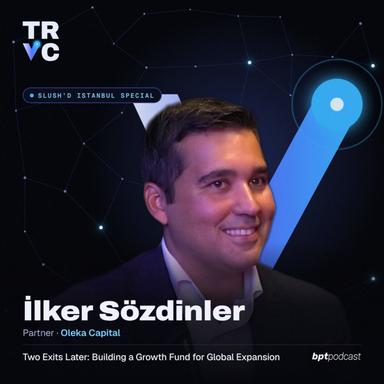
Two Exits Later: Building a Growth Stage Fund - İlker Sözdinler (Oleka Capital) TRVC 39
4 Kasım 2026 · 9 dk
PlatformlardaSpotifyApple Podcasts
What do Turkish startups get wrong when they expand abroad? Recorded live at Istanbul Ignited by Slush’D, İlker Sözdinler, Partner at Oleka Capital, tells Yunus Çelebiler why he moved to the investor side (“the dark side,” as a Star Wars fan puts it) after two exits, NGN and United Payment, now Moka United.He shares the playbook from taking his companies into 12 and then 7 regulated markets: hire local country managers instead of sending people from Turkey, and get comfortable spending real money on marketing. He also walks through how Oleka judges growth-stage companies (unit economics, paying customers, regional scalability), why the team still matters at growth stage, and how portfolio companies like Zen Educate scaled from the UK to the US.Guest: İlker Sözdinler, Partner, Oleka CapitalHost: Yunus ÇelebilerRecorded at the TRVC podcast booth at Istanbul Ignited by Slush’D, powered by Startgate.
Transkript
Welcome to the podcast studio at Slush Istanbul. I have as guest next to me,
Iker Sözdinler, managing partner at OLEKA Capital. Welcome, Iker.
IKER SÖZDINLER Thank you, Yunus. Thank you for the invite.
We've been in touch.
I had a podcast episode on the TRV podcast with Isan and Gin, also a partner at Oleka.
But it's great that this was a chance where we managed to get together finally.
It's an honor for me as well.
One of the many advantages of Slash De Stambla.
I think it's been a very successful conference last year and this year so far, also bringing together so many people.
I always like to start out getting to know, you know, you, your path, your career path.
And so specifically, I know you've exited, in fact, twice, you know, your founder and with successful exits.
What kind of drove you to moving on to the investing side instead of starting another startup?
Sure. So, yeah, as you mentioned, I'm a tech entrepreneur originally.
Did exit NGN, a system integrator, then United Payment, now known as Mocha United.
So after exiting Mocha United, I had a lot of questions in my mind.
Should I do the third one or going to the investment side as well?
So then I saw the need in the growth phase because United Payment became a growth stage company as well.
So not just in Turkey, in the region, I thought there wasn't enough capital and finance in the growth stage.
And the founders, I think, needed better VCs in the growth stage, global expansion, sales, marketing, etc.
The startup VCs are bringing them to a certain level, but when they want to go to another level, I think the capabilities there are different.
So it's a real still kind of founder mindset.
You saw a need.
It's something that we talk about a lot in the Turkish ecosystem.
There's a lot of funds investing in the early stage, but kind of a slightly larger fund that can invest bigger tickets to the growth stage was a little bit lacking.
You saw that need and you went ahead and said, let's fill that need, let's create it.
Yeah, this is what we did.
So how, I mean, how's it going so far?
Sometimes there's a difference between seeing the need and then actually doing it.
You know, how has the reality played out with this kind of the...
Yeah, it's a different story for me also.
So I thought it was going to be easier, to be honest.
So because when you are a founder and executor, the things I see with the opportunities and
when you are not the one who is executing, it's a different mindset and it requires different
mindsets as well.
But up to now, we were lucky.
So all our founders, which we have invested, are doing very well with the global expansion, with their current sales, etc.
So I'm happy and I'm also getting used to being an investor.
So I'm making sometimes jokes as a hardcore Star Wars fan.
Now I said I'd switch to DarkSide.
So you mentioned international expansion with Mocha United Payments.
You succeeded in growing internationally.
How do you see that for Turkish startup?
Do you have a playbook you learned from there that you helped them apply?
Or is it still everybody figures it out in different ways?
How do you view it?
So in my first startup, we expanded to 12 countries.
Second one was seven regulated countries.
So I have my own playbook.
But of course, it differs from company to company.
But the major mistakes which the Turkish companies are doing when they're expanding,
I think instead of hiring local people, they send people from Turkey because of trust issue.
So this is something which we didn't do in United Payment.
If we go to Azerbaijan, Georgia, Uzbekistan, wherever we went for the country managers, we hired locally.
So it worked very well for us.
And also spending, marketing the money for international expansion where our founders are having difficult time
because most of them are coming from a technical background
and they are not okay to spend a few million dollars on marketing.
So I think that's a big mindset change,
which our founders have to do as well.
So it worked for us for two times.
And now we are trying to do in Olika Capital
with our current investments also,
because we don't invest into any companies
which we can't make it regional.
So now all of them, one Waymo,
which we took to in Europe, they are in few countries.
Italy, they are really booming.
only another investment we did now they're in middle east doing very successfully so we are
doing the same play with our investments as well that's a great point the the marketing it fits
hand in hand because you also give them the financing to be able to do that turkish startups
we talk about a difficult environment in turkey so it creates a lot of resilience but also maybe
it they're not used to getting that that kind of the rocket fuel they call it you know a big
investment, but also you have to invest it wisely and where need be spend on marketing.
We really try hard to change our founders mindset, especially hiring a country manager
because they founded everything by themselves. But they know, and as you mentioned in Turkey,
it's very difficult to access the capital. So when they compare the compensation packages of
those country managers with their own, they're having a little bit difficult time to hire
those good executive level people outside of Turkey.
But we give them our playbook and our experiences.
Again, till now it worked.
So we're talking about growth stage
and kind of different reflexes
that companies need to have sometimes at the growth stage,
you know, investing in country manager,
marketing, so forth.
What is different also from your perspective
at the growth stage?
You know, at early stage,
maybe you don't have much to look at except for the team,
but at growth stage,
you can start to look at the financials.
Of course.
What is your kind of criteria that you see that's different from early stage investment?
Yeah, sure.
Early stage, as you have mentioned, the main thing you are looking for is the founder and the team.
So will they be able to deliver it?
Or if they need to pivot, will they be able to do that?
As well, in growth stage, they already have the unit economics.
So we look at three things.
So if the unit economics are okay, if customers are paying or not, is this idea scalable?
And can we take them into a region?
And if these all hit okay for us, we go ahead with the going more detailed investment meetings with those guys.
But again, being regional, sometimes I'm seeing companies doing okay with Unitec economics, etc.
But if the team won't be able to take it to international, we are not doing that.
Gene is still important.
Yeah, founder is still important.
So I wanted to ask you about verticals.
We know that in Turkey, fintech gaming has been going very strong.
Do you see another vertical on the horizon?
Do you have any sort of vertical focus?
What we did, we have some fintechs, regtechs, education tech investments, which we did from UK is booming also.
It's a very easy idea, actually.
It's a replacement teacher platform, which you wouldn't think it would be so big.
Substitute teachers.
Yeah, substitute teacher platform.
It's the Uber of substitute teachers.
They became the market leader in UK.
Then they became the fastest 30s company in Europe.
Now they have expanded to US and doing perfect.
So that edtech investment of ours went very well.
Then educate.
And we also very recently invested into an AI company from SF, Tasklet.
They're also doing very well.
But normally we look at B2B, AI, fintech, insure tech, retail tech.
so we invest
to stuff that
me and our team
understand
so you're
focused quite
globally then
not just Turkey
not the US
but also Europe
but with a
in any case
with a game
for global expansion
so it makes sense
that you're
focused globally
and so Slush
is a great
place to be
for that
because we were
talking about
the beginning
it brought in
a lot of
investors from
around the world
were you here
last year as well?
No this is my
first Slush
and I'm really
impressed
very good
I hope to make some great connections.
This is now, we're still in the first day, but we've had some great sessions so far.
And thanks for joining us.
And thank the StartGate team, a gaming-focused accelerator here in Istanbul that's running the podcast booth.
Thank you very much for the invite again.
you
Bu transkript otomatik olarak çıkarıldı; kayıtla küçük farklar olabilir.