
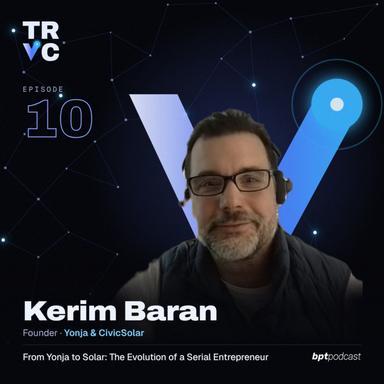
TRVC10: From Yonja.com to Solar Disruption | Kerim Baran’s Journey through Tech & Clean Energy
15 Mayıs 2025 · 47 dk
PlatformlardaSpotifyApple Podcasts
Legendary Turkish-American entrepreneur Kerim Baran, the founder of Yonja—Turkey’s pioneering social network—and co-founder of CivicSolar, a U.S.-based solar distribution company that scaled to $60M in revenue without raising venture capital.
Kerim opens up about his early years growing up in Turkey, his move to the U.S. for college, and his experiences working in the tech industry during the original dot-com boom. He discusses his time at major tech firms like Sybase and Siebel Systems, and shares the origin story of Yonja.com—a social network that briefly outpaced Facebook in Turkey before ultimately being acquired by Tiger Global.
After Yonja, Kerim took time off to explore and reflect, which led him to angel investing and eventually into the solar industry. He shares how he co-founded CivicSolar, initially envisioned as an eBay-like marketplace for solar equipment, but which evolved into a highly efficient drop-shipping distributor serving thousands of installers across the U.S. With deep insight, Kerim explains the economics of solar energy, including Swanson’s Law, the declining cost of solar panels, and the transformative power of distributed energy systems.
The conversation then turns to his investment thesis in clean tech. Kerim reveals his unique three-pronged model:
- SolarAcademy.com – a social knowledge platform where founders, thought leaders, and innovators in solar share their ideas and solutions.
- Seed investments in solar SaaS and platform companies—such as Ivy Energy, which enables solar for multi-tenant buildings by solving the "split incentive" problem.
- Infrastructure capital - deploying capital into solar and storage assets that offer attractive returns while decarbonizing the grid.
Kerim also shares his vision for the future of clean energy, his critique of traditional utilities, and why he believes distributed solar plus battery systems will ultimately outcompete centralized solutions like nuclear for mainstream users. He closes the episode reflecting on Turkey’s solar journey, where he once advocated for solar adoption at the highest levels of government—and shares why he remains optimistic about Turkey’s future energy transition.
This is an inspiring deep dive into entrepreneurship, impact investing, and the future of solar energy—from a founder who’s been ahead of the curve in every wave.
Chapters:
00:00 – Intro & Early Career
06:00 – Founding Yonja.com
13:00 – Yonja’s Exit & Reflections
17:00 – Discovery of Solar & CivicSolar’s Growth
26:00 – Distributed Solar vs. Utility Power
32:00 – SolarAcademy, Ivy Energy & Investment Strategy
38:00 – Clean Tech in Turkey & Vision for the Future,
Transkript
Welcome to another episode of TRVC - The Turkish VC.
Today I'm very excited to have Kerim Baran, founder of Yonja.com, a Turkish social networking
site before social networking was known to the world.
It was a big success here and then he went on to do other things and is now investing
in solar.
And so I'm excited to kind of hear the whole story directly from him.
Welcome Kerim.
Thanks Yunus.
having me. So let's start with that. I kind of know you from those days, but what was the path
from there to where you are now and investing in solar? So maybe I should go back to even before
Yonja. You know, I think my story started in Turkey, obviously. And I think it's important
to talk a little bit about like how I came into doing two startups and then morphed into being
investor as well as still a startup tinkerer. I believe in doing multiple things at once.
I think Elon should not be the only one entitled to do that in the world. I think we all have
multiple tangential interests that we can be involved in. Growing up, that's not what I've
seen in the world. That's not what most people did. It was like you had to specialize in one
thing and be really good at it, usually people put or society puts people in a specific role or box
and say, you really get good at that and that's all you do. And don't think about anything else.
I don't think that's a healthy way of being in the world. So I always kind of like thought out
of the box. And when I was growing up in Turkey and also in early years of career, it wasn't
So common for a young Turkish professional to venture out to the West, live in California
and explore working in California.
And I always pushed myself to try new things and do things that were not done before, or
at least that I haven't seen a lot.
So I've really intrigued by mostly the Western coast of the US and worked for technology
companies.
You were in college in the US after growing up in Turkey?
Yeah.
So, yeah, after finishing high school in Istanbul, I did come to the U.S. for college.
I worked in early stage and larger software companies out of college and then went to get my MBA and actually moved to Turkey for a year after my MBA because I had been in the U.S. for nine years from age 17 to 26.
Right after college, did you move to the West Coast?
I worked for West Coast companies.
My first job was actually working for a French software company in Chicago.
I was their number two hire in the US and helped grow that office to about 20 people.
And then we sold that company to Sybase, which was a West Coast headquartered, largest competitor of Oracle at the time.
And Sybase was acquiring another company out of Boston, which our company fit better in.
And so after the acquisition, we all moved to Boston to be part of that division of Sybase, which was called PowerSoft, which at the time was the leading client server development tool.
But so you really got a sense of, I mean, I'm guessing this is mid to late 90s.
I mean, the software sector in the States was already then kind of happening and you catch the bug, right?
I mean, it kind of.
Yeah. Yeah. I mean, I was always interested in computers and programming.
And I had a more STEM mind than a literary verbal skills, I would say, probably still true to this day.
And, you know, I was always more interested in engineering subjects and software appealed to me.
And, you know, my so my first job was actually selling a database design tool that helped make relational database design easier.
That gave me a good sense of tech companies and power of software.
I still wasn't sure exactly what I wanted to do because I have lots of interests.
And then I went to business school.
After that, I did one year of management consulting with Bain, mostly in Italy and in Turkey.
For a year, kind of seeing where I want to build my career, close to home or in America in tech.
After a year of trying that, I decided tech sector is not really happening much in Europe back then
or even in Turkey. So I bounced back and this time all the way to San Francisco. And I've
lived in San Fran for 15 years after that. And then last 11 years in San Diego.
When I moved to San Francisco, that was like right in the midst of the dot-com boom era.
99 or so.
Yeah. And I had a whole bunch of options to work at various different startups.
The whole dot-com boom was happening.
It was really exciting, but on purpose, I chose a larger company, Siebel Systems, which was really the first true CRM company in the world.
And at its time, it was at its peak too.
And I chose that company because I wanted to work in a big company.
Having seen like going through startups and acquisitions, my green card process had to be reset and annulled and restarted.
So I was like, no, this time I'm going to go for a big company, get my green card and learn also a little bit more about how like the largest and the most successful companies are doing things.
And then I will do my startup was my thinking.
So I went through 99 to 2002, which is kind of like when the last year of the boom and then the crash and then fallout after that.
I've seen that from within Siebel, which also got me my green card and kind of gave me the freedom to explore more freely in the US tech ecosystem after.
Did you actually start Yonja while you were still in San Francisco?
Yeah, I actually.
So after I got my green card, my thinking was I would continue living in San Francisco.
But I did do one thing.
And I usually do this between every major project or every major pivot in my life is I took a year off.
So at the time I was at Siebel, my stock options were worth some money still.
And I was always investing and selling health no matter what.
That was my policy.
Every time I invested, I would sell health.
And that created some capital or some savings so I could pay off my MBA loans and go travel the world.
And that's one thing that I really wanted to do.
So, you know, after the green card, I went backpacking in Nepal and motorcycles, Vietnam, top to bottom and traveled Southeast Asia.
And I really kind of got this sense for the power of digital photo sharing during that trip.
And then when I came back from that year off, or it ended up being six months because I was getting bored and itchy.
Then I saw like how rapidly LinkedIn was growing and Friendster was just out.
And I was like, wow, these are really brilliant business models and brilliant product designs that require almost no capital and have huge impact was what I observed.
And I said, we got to do something like this for all European languages.
And that's how Yon just started in San Francisco with the idea to adopt Friendster.
And MySpace wasn't out, but kind of like that concept to the European languages.
We never really took off in the major European languages.
But with an English-only UI, we took off amongst the Turks in the US.
And then it virally jumped to Turkey and it became a relatively good size website and social networking service used by a lot of Turks.
Yeah. Before Facebook, 2004, 2005, kind of around then.
Yeah, we launched Yonja actually a few months before Facebook.
And it was bigger than Facebook for its first few years because Facebook was limited to colleges only.
Right. Did you run into scalability issues?
I remember Friendster had, that was one of the issues.
Everyone did.
Everyone did.
And, you know, MySpace is something really smart that Friendster didn't do at the time.
Friendster was letting traffic from all around the world use the site.
And MySpace said, you know what?
Only the American users are worth high money for eyeballs to put ads on.
So we're going to limit the site to like we're going to block the site to anyone coming outside of U.S.
That's how they dealt with it.
France there had major scalability issues and they were like many times larger than us.
We did, too. But we solved them.
Thanks to really my brother, Emre, who, you know, and also some of the talent that he recruited, who actually became our key tech CTO and team and beyond.
So then I have a blank then from there to where you are today.
I mean, how did the Yonja story end?
So the Yonja story, Yonja was becoming large enough that it was becoming a major player in the Turkish online media ecosystem.
And at the time, MyNet and MyNet's largest investor or one of MyNet's larger investors, Tiger Global,
they ultimately they ended up buying most of yonja okay for partially defensive reasons and
partially for its potential having said that soon after that acquisition and we didn't sell all of
it but we sold most of our ownership and by the way i did two startups i built and sold two
companies and both of them we pretty much bootstrapped we never got any vc money from the
get-go. And they both became cashflow positive within a year, believe it or not. Very unusual.
Were you getting advertising revenue from Yonja?
We were getting both advertising revenue and also some subscription revenue as well.
Ultimately, Tiger ended up buying it. But soon after, Facebook opened up beyond colleges,
beyond the US and started becoming a major challenger and started affecting our traffic
and users.
A lot of our users started using Facebook and Facebook was a better product, better
team, better design in many ways.
They really got the privacy features right.
And also every profile was a true profile, at least in the early days.
There were almost no fake profiles because it started in universities with real university email addresses.
It had a much more like true profile, whereas in most other social platforms, people created tons of fake profiles and so forth.
And also Facebook really did something well with their privacy features where you could adjust your profile so that others would not be seeing all the details about your profiles, but only limited details.
And then obviously their F8 platform and the whole social graph.
That was another major platform advantage.
So the story ended well.
It ended well for us.
It ended well for the acquirers, too, because Tiger, through that experience.
So how powerful of a platform Facebook was, and they became one of their largest and earliest investors, which allowed them to probably make 100x on their 100 plus million investment into Facebook.
I'm assuming, I don't know the numbers exactly, but they got in early enough that they ended up benefiting from Facebook's growth as well.
Yeah, it's fun to hear the story because Turkey goes in and out of being on the radar of international media and so forth.
And it's fun to hear Tiger Global was a master in several Turkish startups in that time frame.
Yonjo was one that was bigger than Facebook before Facebook, discovered a category and ultimately exited.
We talk now about a lot of the recent successes inside or we keep hearing about those and those are great.
But it's nice to hear that there's been others before, actually, too.
So thanks for taking us down memory lane there.
So then after Yonja, and I did stay because we hadn't sold all our shares and I was still thinking there was an upside here.
And we tried to fight Facebook off for another good two years.
But after that, it was pretty clear that they were going to be the winner take all in the social networking space in the world, pretty much.
So after those another two years post sale, I took another six months off.
You know, I said, OK, like, I don't know what I'm going to do.
I have a lot more capital now that gives me the freedom to really follow my heart rather than
worry about making X amount of money or working in areas that didn't appeal to me.
And so I took another six months off, started investing personally, like created a personal
fund of public equities, and then kind of started sitting quietly and just like listening,
like what what my heart really wants to do and i would have it like an inner voice tell me that
i gotta be involved in education health care and clean tech i don't know why but those were the
three areas that so it was clear to me at this point that i wasn't gonna beat the zucks of the
world okay like i i should not be competing in that arena but i still had enough tech know-how
to apply it to socially impactful areas that were not really benefiting from tech so much
at that time, which was still the pre-2010 era. So I started angel investing and advising in
early stage socially impactful tech startups and done a bunch of investments and like angel tickets.
And then one of my best friends from college, his ex-business partner with whom they had built and sold a business came to me.
And I was friends with this fellow, Michael Goldberg from Pennsylvania.
He and my good friend, Nicholas from college, they had built a e-commerce startup together.
And Michael was really interested in environment and he was really interested in solar.
And he had been working at a solar company for two years.
That was kind of shutting down at that time.
And he came to me and said, Kerem, I have this concept.
Let's sell solar panels online.
And I'm like, OK, sounds interesting.
So I started researching about solar and saw it.
I mean, solar actually has a really powerful dynamic, kind of like the Moore's law.
You know, everything getting cheaper and more powerful in terms of chips.
It's slightly different in solar.
It's in solar.
It's most people don't notice, but installed solar capacity in the world grows at about 25 to 40 percent CAGR steady for the last 40 years.
And so that's on average 30, 35 percent CAGR per year for the last 40 years.
So it's been doubling essentially every two to two and a half years, maybe three years.
And it depends on policy and dynamics.
And some markets grow faster some few years and then slows down.
But if you look at it globally, installed solar energy capacity and also factory capacity is almost doubling every two to three years for the last 40 years.
You should call it like Maran's law.
You know, there's actually a law called Swanson Law. I don't know if we can share screen, but maybe we'll talk about solaracademy.com, which is one of my projects right now. Solaracademy.com, under the Learn tab, there is a chart section there. And it's one of the first charts at the very bottom of that. I show this. Swanson Law is the founder of SunPower, Bill Swanson, and that dictates the decreasing cost of panels.
and so solar panels are not 10 cents a watt when i entered the solar industry 15 years ago with
michael our other partner two michaels and me we we were selling solar panels for two and a half to
three dollars a watt now solar panels are 10 cents a watt in parts of the world in china in the u.s
is still in the 20 to 30 cents range, but that is 10 times cheaper in 15 years.
And so the Swanson law says panels costs go down 10 to 20% every couple of years or something
similar to that.
When the cost goes down, solar becomes more economic in more use cases.
And the same thing is happening to batteries too.
So my vision thesis is that all these old forms of energy and even utility companies that deliver them with wires, they will be disadvantaged to local solar plus storage battery, local solar plus battery solutions.
Anyway, so winding back to the 15 years ago, Michael asking me, let's sell solar panels online.
I was like, OK, sounds interesting.
And so we thought we would create an eBay-like platform, take a 5% commission and connect the solar panel manufacturers with the installers and make a nice website and take 5% commission.
It didn't end up being like that.
It ended up being a much more hands-on, VAR-like distribution business.
But the benefit of the business was that we displayed a lot more quality information on a beautiful website that was really geared towards solar installers, sorting and finding panels and inverters and 500 different related products that go into building a solar system.
And then building a really knowledgeable sales team.
These are like young Ivy League graduates who were passionate about environment, who really wanted to learn everything about it and like learn about how to create cleaner energy and then share that with the industry.
And so we essentially built an inventory-less, negative working capital business model distribution business, dropshipping panels and inverters to various different project sites all over the U.S., all over the 50 United States, and selling solar panels to installers and developers.
In the early days, we would sell the panels and buy the panels from our competitors and drop ship it to the job sites.
And then as we grew, we maintained direct relationships.
But we also maintained direct partnerships with our competitors.
they didn't mind us selling for them because we were so much better in capturing new customers
and getting them into solar and and hand-holding them to do their first few projects that we we
would end up becoming the largest customer for our competitors because we did something that
they didn't do because most of our competitors were brick and mortar distribution warehouses
that were really good in inventory management
and giving terms to the customers and things like that,
which is things we didn't do.
And ultimately, we grew that business.
I mean, we raised less than a half a million of capital for that business,
of which we didn't even use more than $150K
to become cash flow positive in the first year.
And then we grew that business to about $60 million in revenues
with no outside capital.
After that, we got to a certain size
that we had to act a little bit more like brick and mortar
traditional distributors to compete with them
and to grow faster.
And there were several other limitations to our growth
because as long as the new entrants were growing
into the market, we were growing too.
But once the new entrants became established players,
they would learn everything from us
and then grow out of us to buy from the traditional distributors.
So that was the challenge to growing that business anymore.
And we realized that was our limit.
So after a few years of struggling to compete with our biggest partner slash competitors,
we decided to sell the company to our largest competitor,
which now probably controls 50% or so of the distribution market for solar panels in the US.
You had already caught the bug of entrepreneurship and tech in the 19-inch moon.
But here in 2010, you caught the bug of clean tech, but specifically solar, right?
So you've been...
Yeah, I've been very focused on solar.
And also, I have been focused on a part of solar that is only about 20% of solar in the U.S. market.
In the Turkish market, probably 5% or less, I would guess, which is the distributed solar.
Not the largest solar farms that have direct deals with utilities.
but more the residential and small commercial and industrial solar,
like the smaller systems, which are much higher in numbers, but much smaller in size.
That segment of the market is the part that I know much better than utility-scale solar development.
Having said that, I did learn the utility-scale solar development game too,
because we thought that was something we needed to understand and know.
So a few years into our Civic Solar story, which is the 10-year journey of building that distribution company, which was called Civic Solar, we actually created a development division and we developed some solar farms in Ontario, Canada, of all places.
So I led that initiative and built some solar farms in Ontario or partnered with an early stage developer.
We built them and then flipped them to larger asset holders.
We already started getting some notions of investing into infrastructure there.
I find this really interesting because you alluded to it a little bit earlier.
You have a kind of specific thesis, and I want to get to that.
But just first to touch on the point that you just mentioned, because it's kind of part of the basis for the thesis, is the specific aspect of solar, which is that it can be distributed.
When you think of these big solar…
That is what excites me a lot, actually.
I love distributed systems.
I love anything that is not concentrated.
Like I love actually breaking concentrated power and empowering the edges of the system or the bottom of the pyramid, whatever you want to call that.
Yeah, I think that's really interesting that you focus on this aspect of it because it's something I've thought about a lot, that that's something that's specific to solar.
You can put a solar on your, you know, your roof.
Your van.
yeah and whenever we talk about solar as a mix in clean energy you never really hear so much
about that aspect of it you just hear it of you know well you can invest in gas turbines or you
can invest in solar you can invest in nuclear or whatever yeah and nobody's actually talking about
but solar has this totally different aspect to it that means it's very different so yeah because
it's direct it's like direct energy from the sun with no middleman you're getting your electrons
directly from the sun with no middleman.
You can put one panel, you can put a thousand.
And this is what makes,
like this is what will make solar win
against all other forms of energy,
in my opinion, going forward,
including nuclear and others.
Because here's the problem with,
I mean, I think nuclear for AI data centers
makes a lot of sense.
Build a big ass nuclear power plant
right next to the AI data center
that will power however many petabytes of data
That is a smart idea. But for individuals and where you are distributing that energy via utility wires, the problem will be the wires.
because even if you produce $0 free nuclear or fusion electrons,
the delivery cost of that via the old paradigm,
which is the utility wires,
is approximately half, here in California,
more than two-thirds of what you pay for energy.
Here in California, we pay two to three times
the average world price for electrons.
I'm paying more than 40 cents a kilowatt hour, and I don't live in that big of a home.
The larger the home, the more you pay in California.
World average of electricity is now probably between 15 to 18 cents.
We are paying 30 cents just for distribution.
That is just for the upkeep of the wires.
Well, and there's a bunch of stuff in there too, right?
Because it's the wires, but then it's also they have to balance the grid and there's all kinds of things.
If you do nuclear energy, you will still never pay less than 30 cents.
But if you actually cobble together like a DIY solar system with some Chinese batteries and 10 cent solar panels, the 10 year amortized cost of that energy is like 5 cents.
I'm not kidding.
It's like 5 cents.
That's like six times cheaper than just the delivery cost, not counting the electron cost.
That's what's so wrong about the current energy system in the world.
Not many people talk about this.
So this kind of leads to your thesis because there's a reason for that too, which is there's often bottlenecks, right?
So I live in a multi-tenant building.
It's a 17-story building.
And I thought, wouldn't it be great to put solar on the roof of our building?
But then I'd have to get agreement with all the other tenants and with the…
Sure.
Yeah, of course.
And it's not as simple as building a social network or a software system because it's a lot of atoms you have to deal with and not just bytes.
Yeah, absolutely.
And that's why solar is not going to take over the world in two years, but it's probably going to be more like 20 to 30 years because you're changing a lot of physical infrastructure.
That's the problem you're focusing on then.
Absolutely, yeah.
So I have now a three-pronged approach to make more impact in the industry that I'm working in.
The first prong is solaracademy.com, which is a social knowledge platform that invites thought leaders to share about their visions, their products, their solutions, services, so that that message can reach their target audience more easily.
And through that process, I actually get to meet some really amazing early stage solar slash software founders, which in my opinion, the most impactful platforms in solar are when they're coupled with software.
I'm not saying hardware solutions are not needed, but I think software has a special way of codifying processes into how things should be done in an efficient process manner.
And so that makes a big impact. So that allows me to meet the founders and sometimes invest in those platforms. And then those platforms inevitably also enable tons of physical world assets in the form of solar plus storage type energy assets being built.
And those assets have very, very attractive IRRs.
And it's a more physical type of asset that most traditional investors understand more easily than software, especially infrastructure.
And the sophisticated infrastructure investors are very familiar with right now.
And most banks and so forth are still lagging, but they're getting comfortable financing these assets too.
And these assets generally return in the mid-teens to 20 plus percent IRRs unlevered because of the amazing economics of solar.
So you gave me an example the other day.
So a SaaS platform that enables apartment buildings.
Yeah, that is one of our primary flagship investments, IV Energy.
Yeah, out of San Diego here in San Diego.
They solve a really key problem.
So, you know, U.S. has now probably five plus percent residential solar penetration.
Germany has probably 25 plus percent or maybe 30, 35 percent at this point.
Hawaii is 35 plus percent.
Another crazy statistic I will show, there's a concept called balcony solar, which is kind of like you put a couple of solar panels in your balcony and attach it to your outlet and it makes your electric meter work backwards.
And I think Pakistan added with cheap Chinese solar panels in the form of balcony solar, like completely non-permitted, completely bypassing all the rules.
I think they added like 30% of their entire national energy capacity in one year with balcony solar.
But obviously in developed markets, you can't just cobble together a couple of things and attach it to the outlet.
You have to do it according to code, according to permits and all that.
But anyway, in the case of Ivy Energy, what they do is they solve a major problem.
Like a lot of individual households, they go solar.
The homeowner does the math and does the research and then buys a $10,000, $20,000, $30,000 solar system.
And if the home is spending $2,000, $3,000, $5,000 on energy every year, they get a four or five-year payback and they're happy with that.
But in the case of an apartment building, the landlord is different than the tenants.
And the tenants don't have the ability to put a solar system.
Landlord has to put it, but tenants are paying for the electricity.
So there's a split incentive problem.
So because of this, most apartment buildings, most multi-unit buildings have been putting solar only for the common area load.
Meaning, you know, just for the elevators and the hallways, because that's what the landlord owns.
And the rest, which is 80% of the load in the building, has been not addressed for the last 10, 15 years that I've been in the industry.
So this was a problem that I was well aware of.
And interestingly, one of the earliest companies that I invested in, there was a young sales guy working there.
And he came across this problem and he got really pissed about it.
And he said, I want to fucking solve this thing.
And he has done so much in terms of policy, regulation, lobbying, and attaching what was not connected between the utilities and the landlords and the tenants.
and designing a software program that could take all the data and then personalize it
and then generate an accounting ledger by tenant to appropriately credit the solar value
to every tenant that opted into this program.
As a result, turning the landlord into a mini power plant that finances and builds that system
and monetizes it to add a lower price than the utility.
So everybody's winning. And even the utility is winning because there's so much demand for power now.
So this is essentially they're outsourcing the power, the electron generation to thousands of apartment building owners.
You have the kind of your deal flow through Solar Academy and then you find somebody like the founder of Ivy Solar who solves the problem.
And then thanks to that, you then have all these projects you could invest in.
We have not formally launched an asset fund, but this is something that I've done before.
I've built solar assets before and realized well above 20% IRRs for those projects as well.
You've hit on this model and you've been doing these investments yourself so far and you've brought in other investors along the way, but not yet in terms of a fund.
Yeah, between all my angel investments and the SPVs that I have formed to enable companies like Ivy, we've deployed 3 million plus, 3.5 million-ish dollars already.
And sometimes I just invest directly and just bring along 3 to 10 other friends and say, you guys should invest in this too.
So if you count all that, probably we've deployed $5 million in early stage investing into tech, solar slash SaaS slash tech companies.
And in terms of asset deployment, I think that will be more in the tens of millions of dollars in the early stages.
But those things can grow to billions of dollars pretty fast as well.
But we have not done much of that lately, even though we've done some of that in the early 2010s in the Canadian market.
So I want to shift a little bit to ask, have you had any exposure?
Have you looked at all of the Turkish market in terms of solar?
Yeah. So actually, this is something back in the 2012 era, the government, back when Abdullah Gül was president, I think, they did a trip to Silicon Valley.
And I had the privilege of sitting down with the president and some of his key ministers at the time.
And I gave them books about solar and told them what a bright future it had.
And looking back now, I think Turkey has done a lot in solar.
I mean, Turkey is well advanced in solar.
So now, 13 years later, Turkey has close to 100 gigawatts of energy capacity and 20 of that is solar, which is remarkable.
And I've heard from other early stage solar SaaS companies that I invested in in Turkey that now their plans to add another 70 gigawatts in Turkey and coupling that with batteries.
These are really innovative solutions.
Now, distributed solar is not that advanced in solar in Turkey, residential and small commercial.
But that's partially because we have a pretty low energy price in Turkey, too.
I think we're like average or slightly below average in terms of world energy cost in electricity, especially for residential.
So that's not the easiest ROI.
It will still return a decent ROI, but that's not the priority in the Turkish energy market, which probably is the right thing for Turkish dynamics right now.
But adding another 70, when that happens, probably in a few years, that will be 25 plus percent of energy will come from solar.
Maybe 50.
So you've invested in Turkish solar SaaS companies?
Yeah, there's one, Humming Drone, which is a drone. It's really drone technology, but they use also thermal imaging and various other technologies to analyze the performance of existing solar farms and identify any potential issues.
Because whenever there's an issue with a panel or an inverter, there's friction and the heat goes up and you can identify issues.
And they have deeper capabilities to see other wire issues and other sorts of problems as well.
And inefficiencies in solar farms and solar assets can cost up to 10 plus percent of expected value creation per year.
So that is a significant amount.
Do you have any thoughts looking at the startups you've seen in Turkey on the Turkish startup ecosystem, venture ecosystem?
Yeah, the French software company experience that I had 30 years ago becomes relevant because, you know, their ultimate path to exit was they had a really strong market share in their home country, probably with 80 plus percent market share.
And then they were facing competition from American players.
So the founder of that company at the time, from whom I learned a lot, was like, I'm not going to let these Americans come and dominate my market.
I'm going to go into their market and challenge them.
That was how he thought.
And so he opened a sales office in the U.S. and started challenging the American players with his unique advantages.
and then eventually he didn't become the largest gorilla in the jungle but he sold to the second
largest gorilla and joined forces with them and quickly after we sold the business to Sybase
the revenues jumped like by 7x so the buyers got their payback within like one to two years
because it was a software company with minimal cost and seven times revenue bump because of
Sybase's distribution was a huge deal.
And then to this day, it's still a magic quadrant leader in Gartner and still has steady revenues
and a very loyal customer base for 30 years.
So they made like two, three hundred times their money on that one product, probably.
And so I think something like that is very possible for many Turkish SaaS players or
Turkish tech companies, actually.
Everybody wants to come into the American market to sell ultimately because it's such a vibrant trade-based economy.
So you think there is opportunities for Turkish startups?
I mean, it's a typical play or what a lot of venture capital firms are hoping to invest in Turkish startups to do is develop the product in Turkey.
Sometimes from the get-go start selling in the U.S., but sometimes develop the first version of the product here, but then very quickly open a sales office in the U.S.
Yeah, I mean, the example that I saw, local company dominating the local market and then expanding into US.
But in today's world, I think borders matter a lot less.
So you can really create a unique product from Turkey and get global major market share right away.
I mean, if it's a gaming company, you don't even have to be anywhere else.
If it doesn't require, I mean, even if it requires sales, most of sales is done on Zoom these days anyway.
I think it's important to go to the conferences, meet people in person.
But I was just doing a podcast recording with a major solar design software company with no offices.
And they have dozens of employees in probably three, four different continents serving Europe, Australia, US and many other markets with no offices.
And they've raised tens of millions of dollars.
Have you seen enough different startups in Turkey to have a sense of any sort of typical mistakes or typical strong points you see?
A lot of times we hear about strong technical talent in Turkey.
But yes, you can sell on Zoom, but being able to position your product, talk about the benefits, pretty difficult to do.
Yeah.
The one thing Americans are generally better than the rest of the world are marketing.
but I think there's amazing engineering talent all over the world including Turkey, Germany,
India you name it and usually in most startups I'm not saying this is particular to Turkey
but in most engineer founded startups usually you get tunnel vision or like you get engineer vision
disadvantages rather than somebody who like so the best founder in my view is a great engineer
and a great sales guy all in one.
If you have that, that's a great founder.
That's a great combination.
So I want to switch to a couple rapid fire questions.
We are kind of running out of time.
Is there anything that you know now
that you'd wish you'd known when you started out?
In early stage investing,
I think sticking to what you know
rather than spray and pray,
not necessarily for financial returns,
but I think for deeper impact
with the people you work with
is a lot more rewarding. I have found that out. Is there anyone you'd like to make a shout out to?
My partner in Solar Academy, Nico Johnson. Nico started podcasting in the solar industry
seven years ago. And to this date, he has interviewed 800 of the most important leaders
in the industry. And I think those conversations are very inspiring and educational for others to
take actions that they normally wouldn't. Because one thing that Nico does really well is he brings
out how people took a courageous step in a direction that was kind of a no-no, but they
did it anyway and then ended up being usually good. Sometimes not, but still very educational.
And is there a favorite book you'd want to mention?
The Prize by Daniel Yorgin is a good book.
I don't know if you've read it.
It's about energy and how energy played a key role in world history, especially in the Second World War era.
It talks about how German tanks stopped because they didn't have access to oil and how important energy is in many ways and how we fight over energy.
The biggest wars have been fought over energy.
And I think solar is inspiring because it democratizes access to energy for the world in ways that other sources of energy cannot do as easily.
Is there anything you would want me to ask that I didn't ask?
No, but I have a question to you, maybe, which was the topic that we briefly discussed.
And this might be useful for foreigners that are not familiar with the Turkish VC ecosystem to understand how the VC ecosystem is being built.
And what are the current legislation that is helping that happen?
And maybe it could catalyze more investments to come into the Turkish ecosystem.
We were talking about there's the Turkish legal framework for venture capital funds, just the Giresim Sermaye Yatırım Fonu, G-S-Y-F-G-C-F-E.
And there's tax incentives both for tech companies, for R&D and for investments in these funds.
The second episode was with somebody who is at a techno park, Yıldız Technical University techno park.
And we talked a little bit about the techno park R&D incentives.
So that's one thing. And the tax incentives for the local venture capital firms, I think, is worth an episode.
But if you could summarize it, because potential LPs in the US, as I'm exploring Turkish LPs, a few bullet points that summarize it would be good.
I understand whatever a large corporation in Turkey is getting as tax benefits from their R&D, they have to invest a small percentage of that into VC funds that fund early stage startups.
Is that a fair summary?
Yes, exactly.
So companies get tax incentives for doing research and development.
And then of the amount that they get as a tax incentive for doing research and development, 3% of that used to be 2%.
It's currently 3%.
They have to invest in these local domicile venture funds.
And those venture funds, part of that legal framework, they can have up to 20% of their funds invested abroad.
Abroad.
And there's other, so there's equivalent to a 401k kind of system in Turkey.
It's called the individual retirement system.
And a small percentage of all the money in those retirement plans also has to flow through to local Turkish venture capital firms.
And those venture capital firms, so the kind of investments that they can make, the definition of startups or tech companies that they can invest in is comprised of three things, basically.
Tech companies, renewable energy investments, or then the catch-all, just generally high potential growth companies.
So renewable investments is actually one of the categories that they can invest in as venture capital.
So it's a bad framework.
It's pretty new, right?
It's been less than 10 years.
So there's basically not a single fund that's run a full 10-year cycle yet.
But it's a good start, I think.
And we'll see how it develops.
Great.
Thank you for sharing that.
Awesome.
Very cool.
It was really great to have you on the podcast.
That was fun.
Have a good day.
Thanks.
Thank you very much.
Take care.
Bye-bye.
Thank you for listening to this episode of the Turkish VC Podcast.
My name is Yunus Çelebi.
that. If you enjoyed this episode, please
like and subscribe and tell your friends.
You can listen to more episodes
wherever you find podcasts on Spotify
or YouTube, etc. Stay tuned for
further episodes.
Bu transkript otomatik olarak çıkarıldı; kayıtla küçük farklar olabilir.