
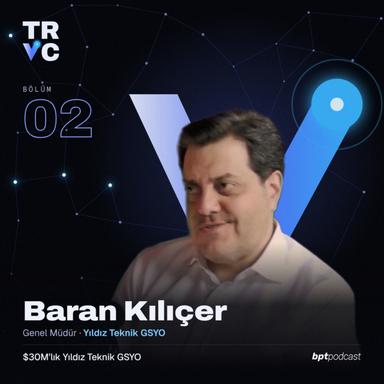
TRVC #02: Baran Kilicer of Yildiz Univ VC Trust on University Technology parks in Turkey
3 Mart 2025 · 36 dk
PlatformlardaSpotifyApple Podcasts
Baran Kılıçer, of Yıldız Technical University technology park venture capital trust, gives us a deep dive into a particularity of the Turkish startup ecosystem: the universtiy technology parks.
Baran has a background in investor relations before joining Yıldız Technical University technology park and helping to launch their venture capital trust. Baran also shares some stories of some of the most common bottlenecks facing Turkish startups in growing globally. A great primer on some of the idiosyncracies of the startup ecosystem in Turkey.
Transkript
Welcome to the Turkish VC podcast where we talk about the Turkish entrepreneurship ecosystem
and VC in Turkey.
And today my guest is Baran Kılıçer.
Baran is with Yıldız Technopark, Yıldız Technical University's Technopark, and he
is head of international operations and investor relations.
I'm super excited to have Baran with us today because I want to ask him a little bit about
Technoparks and the role they play in the Turkish entrepreneurial ecosystem.
I think he has some really great experience there and good insight.
Baran, actually, first, I'd love to start with kind of your background.
I know you studied in the U.S., you've lived in different countries abroad, and then came
to Turkey.
I'd love to hear kind of how you made your way into the space of VC and entrepreneurship and
techno parks. Well, I lived six years in Saudi Arabia where I went to middle school and then I
moved to LA for high school and university where I studied international business at California
State University, Long Beach. And then I did my master's degree in entrepreneurship and innovation
at Yildiz Technical University. Before I came to the startup ecosystem, I was doing investor
relations because I have capital markets activities licenses and corporate governance
licenses. So I felt quite bored in the stock market and selling shares. Then I looked into
opportunities where I can use my knowledge and my licenses. And I found out that there is this
venture capital ecosystem, which then led me to the startup ecosystem. And that's how my story began.
Wonderful. That strikes a chord with me because I often find that people who are attracted to VC
it's something a bit more meaningful, right, than a lot of the other kind of asset classes.
It's something more than just financial.
You have an impact.
And especially in Turkey now, we're seeing the ecosystem develop pretty much from scratch.
Tell me a little bit about your experience at Yıldız Technopark.
You've been there for a number of years.
You've seen the Technopark space develop.
Tell me a little bit about the Technopark system in Turkey.
There are incentives, tax advantages for companies in techno parks, and they're tied to universities.
Can you tell me a little bit about the techno parks?
When did they start?
How many are they?
How are they developed?
The techno park ecosystem in Turkey is actually world-leading because there is 104 technology parks.
Most of them are part of the university.
They are regulated by the Ministry of Industry and Technology.
and the ministry wants them to work with universities and be a part of a university
although there is a few that are directly run by the ministry themselves but what a techno park in
turkey compared to other parts of the world is actually it's an r&d and technology development
zone so it's not just where you have startups but you have r&d companies doing a big corpse doing r&d
within technology parks.
And the reason why they do these here is
any company that does R&D, including startups,
they don't pay any income tax, no corporate income tax,
which is 25% in 3K.
If they're hiring any R&D employees,
those employees don't pay any personal income tax.
There's 20% VAT.
If you're developing anything
within a technology development zone, no VAT.
The only thing that companies within these zones pay
is 50% of social security tax
for the people that they hire as R&D.
So this is a great advantage.
Besides that, because they work with universities,
they use the know-how from the academicians.
In fact, for example, our university, Tech Park, has 750 companies.
A hundred of them are academic partners.
Because when a founder or a startup has an idea but needs more know-how,
they can take the professor or the academician as a partner
and grow much faster with the know-how,
where the government gives you support on that.
The University Technology Transfer Office is often involved as well.
Yes, the Technology Transfer Office mainly helps you with that connection with the university itself.
And then we also have a department which is an incubator.
But incubators are for companies that are three years or younger.
So at their pre-seed stages, they would develop within the incubator.
and what's special about the incubators in Turkey
is that world's number one university incubator
and world's number 10 university incubator
are both in Turkey.
So we do have a very good incubation ecosystem
where from there on, right away,
from an incubation center,
they move on to a Technopark R&D company
and continue doing their R&D all tax-free.
And can you give us a sense of the size of,
for example, the Yildiz Technopark?
Size in general, within these 100 plus techno parks, there is about 80,000 R&D people working with about 2,000 companies in all.
Yieldus has about 15,000 people within the ecosystem, within those 750 companies.
We have about 200 plus incubation companies, which is off the 750.
And we do startup programs for Google, Microsoft, and Sandbox, where we also help them find startups and sell their products to founders.
You were involved as well with setting up a VC fund as part of Yieldless Technopark.
And tell me a little bit about the structure, right?
Because it was under the local Turkish sort of legal framework.
And there's two different frameworks you can do a VC fund under in Turkey, right?
Yes.
In Turkey, VCs are regulated under SPK or the Capital Markets Board of Turkey.
And we have about 400 plus venture capital funds or trusts in Turkey.
So it's been a booming sector where I think in 2023, it was about 270.
with coming up to 2025 we've gone over 400 bcs but the regulation here it differs a little where
in our university we have a venture capital trust which in turkey they call a gsyo where you have a
entity you're a corporation you invest in startups again there's tax advantages any money that any
company or person invests into this can deduct some of this from their tax payments but with a
venture capital trust, you take all the management fee and you do all the management.
The other legal structure is the GCFA, VC fund proper, but which is operated kind of like a
mutual fund. It's operated by a fund management company. And so it doesn't have its own legal
entity. It's just a financial construct, a fund that's operated by a fund management.
Definitely. Yeah, exactly. A portfolio management company becomes the general manager of the fund
and they do all the legal stuff for you,
then you pay half of that management fee to them.
But again, you really get a lot of work out of your hands
and you just work on your project.
And when you set up the GACEO,
the VC fund for the,
or the VC trust for Yildiz Technopark,
was it set up with a timeframe, a fund lifecycle?
Is it also a 10-year fund or what's the horizon?
Well, with a venture capital trust,
By the way, we formed it with HulkBank, Calyon Construction, and Telecom Ventures, with Yielders and HulkBanking lead investors.
If you are a venture capital trust, within three years, you need to do an IPO.
On minimum basis, 25% of the fund has to be sold to an institutional investor.
It can just be one person, but it has to be sold.
If it's not sold, that's where the handicap comes in on having a venture capital trust.
If you are not doing an IPO within those three years, you become a regular incorporation.
You lose your license of being a fund.
And so you lose the tax advantages.
You lose the tax advantages.
You would have to sell back all the shares to somebody else, just like selling regular incorporation shares, which is a big headache.
So a lot of people are afraid of this.
That's why the number of venture capital trusts in Turkey is much, much less compared to a VC fund because it's just much less work.
Now, how would you explain kind of the intuition or the thought behind that structure?
So the idea is the investor, because you already had lead investors, so the investors put money into the trust, but then the trust has to sell it on to somebody else.
Right.
So what do you, I mean, do you have a sense for what's the mental model there?
What's the advantage of selling it on to another investor?
I mean, you've already attracted several partners, investors.
Okay.
If you're a venture capital trust and you've done your initial 25% IPO and you want to
move on, you can take it directly to a stock market and act like a real estate investment
trust, which there's like 35 of them in Turkey.
and then you just directly act as a publicly traded company.
Okay.
But if you're a venture capital fund,
then you have to go to the TEFAS platform,
which is the Turkish fund.
Virtual fund trading.
Yes, it's that platform where there is,
I believe about 2,000 funds there,
but then they are under that portfolio management company
and you buy it directly from that middleman,
which is the portfolio management company.
So the idea is kind of with the venture capital trust model
is a little bit like a real estate investment trust.
Very, very similar.
To be able to be publicly traded.
Exactly.
In fact, they're under almost a very similar regulation.
Venture capital trust and the real estate investment trust
work in very similar ways in regulation,
except they don't invest in real estate,
but they invest in tech.
So you become publicly traded.
You have a market cap.
Your shares are sold on the stock market
where on a venture capital fund, you're not that flexible.
It's really interesting to see how it's evolving.
I mean, this legislation is fairly new.
It's still playing out its course because we had 237 funds a year ago,
now close to 400.
So it's still kind of being played out as the incentives roll out
and the legislation kind of gets digested by the market, if you will.
I mean, where do you see the ecosystem going?
I mean, what are the biggest gaps right now that will be filled in the coming years?
We don't have, we do have a lot of funds.
But the thing is, in Turkey, you can spend $2 million.
Once you invest $2 million, you become a venture capital.
This is a small number compared to the global ecosystem.
So although the numbers are high, the investment is quite low.
We need foreign investors investing into these funds.
But then the regulation says all of this money has to be invested into Turkish startups.
So that kind of blocks it.
And to bypass all these regulations, some investors go to countries like Netherlands
or the UK to start their fund and then come back and invest in Turkish startups.
So the other gap is most of these, I mean, a major amount of these funds are pre-seed.
So I believe we might have only one or two pre-IPO funds.
So we're very strong as a country, as a startup ecosystem, within that pre-seed stage, because the ticket sizes are ranging from $100,000 to $500,000.
You don't see $5 million, $10 million invested in a company regularly in Turkey.
So that's where the big gap is.
Yeah, so the kind of the follow-on stage, the seed, the A Series A.
Exactly. All that growth stage is big time missing here.
that's when companies become international.
And that's where I actually come in
and help them go to other countries,
do their soft landing and find investors
and do all the legal framework
because they have to go.
We literally don't have that growth stage
at that level, Series A and beyond.
Like London Stock Exchange keeps visiting Turkey
and looking for pre-IPO companies
because they have a huge amount of pre-IPO investors,
which is something we don't have in Turkey.
So let's talk about that a little bit, because we talked about the VC trust that Yildiz Technopark set up.
But also you were involved in international operations.
You were involved in setting up sort of beachheads in different countries for technopark startups to be able to grow internationally.
Tell me a little bit about that.
Well, Turkey, like I've been saying, is a very good incubation country.
But for growth, our economy doesn't allow them to grow to a certain stage.
The population is not that big enough, so we need markets like Europe, like all of Middle East, US.
And these companies want to go abroad and grow their business.
We also do get invitations from these locations, especially from Netherlands, UK, Germany.
Lately, Austin has been very interested.
Austin, Texas.
Definitely.
They are actually visiting our country and inviting tech companies to come to those regions.
But again, the problem with a tech startup is that they're usually the founders are engineer or developers and they don't know internationalization.
That's another big gap in the ecosystem in Turkey is that commercialization stage.
So I try to help them go to these locations, meet with the ecosystem players, meet with the right people, and speed up their process in entering the market.
Because that's, again, a huge gap in the ecosystem here.
So we were talking earlier, I mean, as part of this process, you've talked with a lot of people in ecosystems in other countries.
You're mentioning Germany, France, the UK, US, Saudi Arabia.
Yeah. What is your sense of their view of the Turkish entrepreneurship ecosystem?
When you look at Europe, they are quite aware of the ecosystem here.
You know, I said two of the universities have global top 10 awards.
These are awarded by UBI Global of Sweden.
But returning to the US and the Middle East, we're not well known.
And I think that, especially at a government level, that we need to do more connections in this field.
And where the problem comes in, when I also talk to government officials, they focus on our big sectors like tourism and construction and textiles.
And they always skip the tech ecosystem, which is quite new in Turkey.
When I say new, I would say maybe in the last 15 years, when you compare it to the Silicon Valley, we're like just taking baby steps.
But when you look at all the statistics, the ecosystem is growing very, very fast.
and we do have unicorns.
We do have companies that have gone international.
In fintech, we're going quite well.
In gaming, Turkey is going very fast.
We do have interest, but again, mainly from Europe.
Interesting.
It is the closest market, but the U.S. is huge, right?
It'd be great to be more on the radar in the U.S., right?
Definitely, but one of the obstacles that we have
is the visa problem.
So when a Turkish startup applies to get a visa to the United States, they're going to wait more than a year plus to get a visa.
Where if they apply to the United Kingdom, they can get their visa within a year, within a month or two.
So that visa is a huge obstacle.
And when I talk to these companies and ask them why they don't focus on the United States, it's the time difference.
So to have a 9 a.m. meeting with LA, you have to be on your computer at 8 p.m. here in Istanbul.
and that time difference makes it hard for companies to go global
because they have to focus on the U.S. alone
and forget all the business here
or they have to be big enough to hire somebody locally
and do business growth.
And so, I mean, what is your view?
What do you think is the right approach for Turkish startups?
Do you think they should do more to try to go into the U.S. market
just because it's such a big, I mean, it's kind of the home of technology
in Silicon Valley and a huge market?
Or do you think these are valid reasons for wanting to go to Europe or Middle East instead?
Well, according to TechCrunch's news just published this week, 50 plus percent of all world's venture capital investment happened in the Silicon Valley.
So when you said, should they? They have to.
I mean, and when you look at L.A. and San Francisco and Austin, there is cash, but that's smart cash.
It's like if you went to Middle East, if you went to Saudi Arabia, there is cash, but they don't understand what a startup is.
Where if you go to the US, you have investors that you can actually talk the same language.
Aside from that, the Turkish Ministry of Trade helps these companies to go abroad just to boost the export of technologies.
They pay up to 70 to 80 percent of their costs in opening offices locally and going to expos of their marketing costs.
So with the government supporting them with so much instruments,
they should definitely open up the U.S. and look for opportunities.
Well, then this problem comes in.
All they know is Silicon Valley, but I think there's opportunities all over the U.S.
and they don't know which state to go to.
Sure, sure.
That's kind of, yeah, I mean, it's so vast.
Where do you start, right?
I mean, there's a lot of beachheads you could think of, New York, Miami, but it could be anywhere.
Well, if it's a mobility, I tell them go to Detroit.
We do work with Eastern Michigan University.
So it's up to which sector they're in.
But in gaming, LA and New York is quite good.
Before they choose a state, they have to look at some states do have incentives and help out companies on building their venture.
What's your view on relocation?
I mean, do you have the view that really if they want to break into the market, you know, at least one of the co-founders should move to, you know, that geography?
If you're working with the U.S., because of the time difference, because of the size of the market, they have to.
It's impossible for them to succeed if they don't have either a local partner or one of the founders there.
And does that work to have a local partner?
Yes, it does if they speak the same language.
if they know what you're doing.
It's not like, oh, I have a cousin there.
He lives in San Francisco.
I think he can do this for me.
Well, no, because you need someone who knows the market.
And you should be willing to split your earnings in general.
And, you know, take them on board kind of as a co-founder.
And, I mean, is there a Turkish diaspora that can be, you know,
sort of taken advantage of there?
Or is that kind of not so easy to do, actually?
There is.
In fact, I heard at an event in London that there is a big group of Turkish startups that have already become a California startup and that investors are interested in these startups that are in the Silicon Valley.
Well, then I was thinking, isn't startups much cheaper in Turkey to invest and then take them to the Silicon Valley?
Well, then somebody said, you already have one that's internationalized and that's one already localized in the Silicon Valley.
Why not invest in a really made venture?
So then there is a Turkish group of startups there.
So yeah, so that's another kind of thesis.
Another approach is investing in kind of,
sometimes it's called immigrant founders, right?
So invest in Turkish founders
who have started a company in the US
or already sort of flipped their company up to the US.
That also helps the investors with the language barrier.
Because they're already kind of used to speaking.
There's a Turkish talking to Turkish,
but they're both in California.
A personal connection between the investor.
And another market like that is Germany, where you have a lot of second and third generation Turkish founders who is ready to come into Turkey because we have so much tax advantages.
But it's vice versa.
If you go to Germany, you'll find a lot of Turkish startups, a lot of Turkish tech companies that is looking for investors.
So in my opinion, the startup ecosystem is very global.
It's very borderless.
It's just that the regulations that limit where the money goes.
There's ways around this.
people find you could build, you could start a venture capital fund in Amsterdam and then invest
in a Turkish startup. That way you're, say, less regulated. There's ways around it.
And what makes Turkey exciting for you in terms of putting your time and your energy into helping
the Turkish startup ecosystem flourish? I mean, how do you see it as different or particularly
inciting at this time versus Paris or Berlin or Austin, Texas?
What excites me in Turkey is that the government really supports.
They have the national technology movement by the Ministry of Technology and Industry.
You have the Ministry of Technology giving you tax-free for R&D and development.
You have the Ministry of Trade supporting you for going abroad.
And then the regulation makes you work with universities.
So the ecosystem is actually very good in producing startups.
But how we said earlier is we have that problem in the growth stage.
That's where the government doesn't come in.
I do travel a lot and talk with other government officials in different countries,
and they're all wowed by the government support here.
But I like it that we're producing,
and I want to take these ideas and startups to different countries.
And everywhere I go, I've talked with Prince Edward, Duke of Eddington.
I talked with the Minister of Investment in Saudi Arabia, and they were all shocked that they didn't know about the ecosystem here.
So we need to get heard because we have a very good ecosystem.
And within the ecosystem, do you have any sector views that you find are particularly...
We know that gaming obviously often comes up as one in which Turkey is a top player.
Are there any other sectors you have a view on?
We are quite good in fintech.
Well, gaming is definitely, you just mentioned it, but very, very good in fintech and insurtech.
But the problem with those sectors is they're heavily regulated when you go international.
And so each country kind of has their own regulation and you can't necessarily apply.
Exactly.
You know, what worked here?
You could work with a bank in Turkey and sell them a software.
You know the banking system here, you know the regulations.
But when you want to apply this to Dubai or to Berlin, you need to know the regulations there.
and you can't just use everything there.
So, and in the ecosystem, in the fintech ecosystem here,
founders are usually focusing on the Turkish market
and developing their product here.
Once they need to go international,
the product is not ready for internationalization.
That's one mistake about 70% of them does.
Aside from that, we do have a good ERP development.
Mobility is going quite well.
AI is going fast.
I'm hoping to see nice AI companies coming out of Turkey.
I think what we're weak on is agriculture.
Turkey has good agriculture.
We have strong agriculture.
On agri-tech, we are very, very weak.
When I went and talked with Netherlands and Spain
and tried to make some research on the agri-tech vertical,
I found out that there was only three companies
within Yildiz Technopark.
But that's actually one area that we are weak on.
and cybersecurity is a good sector here in Turkey also
because the Turkish mind is kind of an entrepreneur mind
and they always try to find a way around things.
So with that mindset, cybersecurity...
So we can think of the other side of the table as well.
Exactly.
Think of all the things that people will try.
I wanted to ask you if you have any stories,
sort of success stories or failure stories that you could share.
either a company in Yildiz Technopark that you think really stands out, or, you know, like I
said, it could be either a success story or a kind of a challenge story of something that shows kind
of some of the problems that need to be solved. Very interesting question. I haven't thought of,
I did have quite interesting experiences, but one thing that I always remind myself,
I met with a fintech company who sold software to many Turks as more than 100 employees.
And they asked for internationalization support from my department.
So I couldn't tell them, why don't you just hire an international sales manager or something and just solve this?
100 plus employees.
They do have good customers.
So it's just that to us, it might seem so simple.
People with a team of five people might even go international.
but there is then I found out that there is many companies that are not able to go international
because they're just so focused on developing that's what triggered me into making more business
in this area so but then on the other side I saw a startup it was a lady and her husband doing
a blockchain bot which they did speak good English but they know nothing about business
but they already found the customer in the USA.
They already closed their sale and everything was done.
They did not ask for investors, no nothing,
just like two people in the company.
So I was like, then what do you need?
Just find me a good lawyer in US so I can close this deal
because I found these people online
and I've never been to the US.
So you have companies that are 100 plus employees,
can't even go abroad.
And you have, on the other hand,
people with just two or three,
companies with two or three people within them
already made a sale in a country which they've never been to.
So you have the full range.
Right.
So that's great to hear.
Hopefully there'll be, you know, successes create aspiration.
So the more success stories like that that there are
will help draw more companies, more Turkish startups
to kind of take the leap and take that jump.
We will be hearing about those stories a lot in the next few years.
I am hoping within approximately two years, by the end of 2027, our economy would be getting a little bit better.
And because right now the government supports have gone down a little bit, I think because of all those budget cuttings.
Once those get back in track, you will see Turkish startups in the global market and you will hear more.
I'm hoping to have more Turkish unicorns around the world.
But again, we need bigger ticket sizes in Turkey so that these companies don't become a foreign company.
What do you think is more likely?
Do you think we'll see larger Turkish venture capital funds develop, perhaps with foreign LPs putting more money into Turkish venture capital funds?
Or do you see it more likely that we'll see larger foreign VC companies investing directly in Turkey or kind of a mix of both?
Do you have any view on that?
Yes. I've talked to funds from San Francisco, from London, Abu Dhabi, Dubai, Saudi. Their main
goal is to find the company and not invest enough so that they're not a fund of funds.
But they're all interested in this company. Recently, we had venture capital from Qatar
enter the market. They have a $30 million fund looking to grow into $100 million. They're
supported by the Qatar Investment Fund. So we do have foreign VCs coming in, but at the end of the
they don't form a legal entity here. They're just looking to invest in companies. I'm hoping that
the regulation in Turkey will become a little more flexible where foreigners can bring in money and
form their venture capital fund within Turkey to invest in Turkey. I believe the reason they
don't do that is a very small percentage of the fund can only be invested in foreign companies.
Right. But does it make a difference? Why not just have foreign VCs invest straight
into Turkish companies? Does it make a difference if they create a Turkish venture capital fund?
No, if they don't create a venture capital fund, Turkish fund, then what they want to
do is they want to take all the IPs and they want to take the founder to their country.
But now we keep losing these tech companies. When you look at some of the companies that
have become a unicorn out of Turkey, they're headquartered in different countries right
now. So we were actually losing these technologies, but all the R&D and all the production is done
here. Yeah. So, I mean, isn't that fine? I mean, if you think of, I don't know, think of Estonia
as an example, or I don't know, or Sweden. Actually, it's a good question. Is Spotify
still Swedish? Skype became US. I mean, what's another, perhaps a better example is,
what about Romania and UiPath, right? UiPath flipped up to a US company, but it's still a
great success story for Romania. It's up to whose shoes you're in. If you are the government,
if you are the ministry, if you're looking for taxes, well, okay. Many countries right now,
including UK, France, Germany, are doing a lot of FDI activity. They are looking for
foreign direct investment. Even Saudi Arabia is doing it. When Saudis are known for investing,
they're looking for investment coming inward. So this is a major trend right now. And what the
purpose of this activity is they want to bring in other companies to their country, form
a legal entity and hire people.
So because this has a big effect on the unemployment rate.
If you have Turkish founders move their IPs abroad, you're not going to be able to create
as many jobs.
You're not going to be paying more taxes.
It will make a lot of founders very rich, but macroeconomically, it's not going to affect
the country as much as expected.
you have the R&D still in Turkey.
Right.
And you have revenues from a global market.
Well, this is an argument that goes on in the market.
And they say, I think like you,
I say this founder is going to get the money,
buy a house in Turkey, buy a car in Turkey,
spend the money in Turkey.
Maybe if they exit successfully,
invest in other startups, invest in a Turkish venture capital fund.
This is exactly what they do, by the way.
This is exactly what they do.
And the founders are a great resource for the ecosystem.
But then, like I said, on the government's point of view, they think that this is actually taking the assets out of the country.
They think that this is taking the tax out of the country.
So it's up to which side you look at it.
How you look at it.
Is there a question that you would have wanted me to ask you that I didn't?
In my opinion, I think that in the next coming years, foreign investment will be coming in with
Turkey because of the ecosystem going much stronger. When you look at the amount of
venture capital funds going from 270 to 400 plus, there is going to be foreign investment interest
towards this way. So I do believe that there's a good future here, but we just need to get over
with this global economic crisis,
and hopefully the wars will end,
and Turkey has a bright future within the ecosystem.
In some sense, the Turkish economy is somewhat,
you know, on the glass half full side,
it sort of doesn't matter to some extent
how well the Turkish economy is doing
because successful startups can sell internationally, right?
If they end up, as we were just talking about,
flipping up to a U.S. entity and selling in the U.S. market,
then it doesn't matter what the Turkish market is doing as long as they succeed in the U.S.
But on the other hand, I see what you're saying because it definitely helps.
Having the Turkish economy doing well, everybody's more relaxed.
There's more money into Turkish VCs.
There's more appetite to fund businesses.
And even just from family and friends, people will find money easier.
But it has an impact in that sense.
And of course, not all companies go international right away or if at all, right?
There's some number of companies that will successfully also just, you know, address a Turkish market or a regional market.
There is that.
Okay.
What's special about the Turkish market is there's the opportunity of arbitrage.
If, say, you have a mobility company here that's worth a million dollars, if you took that company to Detroit, that startup is going to be worth like three, four million.
But that startup doesn't have that mindset or the knowledge of going to that area and growing their business.
But that's why investors should come to Turkey.
Look for these companies.
And if you're in terms of exit, there is a great opportunity of arbitrage.
When you compare it to, say, India or Uzbekistan or Pakistan, where a lot of people look for startup, Turkish engineering and Turkish technical university ecosystem and the talent here is much different because we are Eurasia.
So we have a European sense within our culture.
But then we're, again, not Europe and Europe.
This is a debate that's been going on for 100 years.
But again, this is a big advantage.
This is why we can go to Europe, we can be successful,
and we have that understanding of quality.
This is why Turkish companies are very promising.
Awesome. Thank you for that.
I'll do a little sort of thank you wrap-up.
So we had a great talk with Baran Kılıçer from Yıldız Technopark,
and he really gave us some great insight into the Technopark setup,
the venture capital kind of local domiciliation legislation, and also about international
operations, local startups moving outside of Turkey, which is a key step. So some really
great insights. Thank you very much for joining us today. And I hope to have you on as a guest
again in the future, because I know that you're interested in some new projects. We didn't get
to talk about them today, but I think you'll be in this ecosystem for some time to come. And I
I hope to hear some great, great successes of what you do in the future.
Hopefully we'll talk about new ideas because, like I said, the ecosystem is developing and we're going to need new things, which I believe your knowledge is very important in that development, in the whole ecosystem.
You being a big part of a tech company is a big asset for the country, for the startups.
So I hope to have you more involved in the ecosystem.
Great. Thank you. Thank you.
Thank you for listening to this episode of the Turkish VC podcast.
My name is Yunus Çelebi.
If you enjoyed this episode, please like and subscribe and tell your friends.
You can listen to more episodes wherever you find podcasts on Spotify or YouTube, etc.
If you have any suggestions for people you'd like me to interview,
or if you're looking to connect with the Turkish VC ecosystem,
feel free to reach out.
You can find me on LinkedIn.
Stay tuned for further episodes.
Bu transkript otomatik olarak çıkarıldı; kayıtla küçük farklar olabilir.