
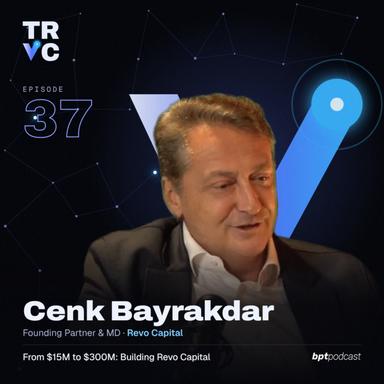
From $15M to $300M: Building Revo Capital | Cenk Bayrakdar (TRVC 37)
7 Ekim 2026 · 51 dk
PlatformlardaSpotifyApple Podcasts
From a $15 million initial commitment to roughly $300 million under management, Revo Capital has grown alongside Turkey’s venture capital ecosystem.
In this episode of TRVC, I sit down with Cenk Bayrakdar, Founding Partner and Managing Director of Revo Capital, to talk about his journey from Arçelik and Turkcell to becoming one of the pioneers of venture capital in Turkey — and what he has learned across three generations of Revo funds.
Cenk shares the personal experience that helped shape his mission: seeing world-class technology developed in Turkey passed over simply because it came from Turkey. That experience ultimately became part of the motivation behind Revo — backing Turkish technology talent and helping companies compete globally.
We discuss how Revo’s strategy has evolved from Fund I through Fund III, including why “Turk-to-Turk” exits can struggle to generate venture-scale returns, why Revo increasingly helps its portfolio companies establish themselves in global markets, and how it is now reconnecting Turkish founders already abroad with R&D talent and incentives in Turkey.
We also get into the mechanics of building a major VC platform: working with institutions such as IFC, EBRD and EIF; Revo’s hybrid Netherlands–Turkey fund structure; the benefits and constraints that come with DFI capital; and the gap Revo sees in Turkey between abundant seed funding and scarce Series A and B capital.
Cenk discusses several of Revo’s investments and exits, the firm’s expansion into San Francisco, and how Revo is building its own internal AI tools for sourcing startups, monitoring portfolio companies, identifying potential investors and buyers, and finding Turkish founders and talent around the world.
Finally, we talk about recurring mistakes Cenk sees among founders, why fundraising should be an ongoing process, the importance of hiring people better than yourself, what Turkey needs to do to benefit from its growing entrepreneurial diaspora, and where he sees the ecosystem heading over the next five to ten years.
Chapters
00:00 Introduction
01:04 From Arçelik to Turkcell: Cenk’s early career
07:57 From corporate innovation to venture capital
11:23 The experience that shaped Cenk’s mission
13:08 Building Revo: from $15M to $300M
16:50 Why Turkish startups need to go global
18:01 Fund III, the diaspora and bringing R&D back to Turkey
21:22 The benefits — and challenges — of DFI investors
25:04 Why Turkish companies struggle to achieve global valuations
28:08 Turkey’s Series A and B funding gap
30:06 Fund III investments and Revo’s move into San Francisco
34:04 What Turkish founders get wrong
39:03 Exits, secondaries and selling to global buyers
41:01 How Revo is using AI inside the VC firm
43:04 The next 5–10 years for Turkey’s startup ecosystem
45:13 Books, podcasts and the people who made a difference
About Cenk Bayrakdar
Cenk Bayrakdar is the Founding Partner and Managing Director of Revo Capital. Before founding Revo, he held senior technology and product leadership roles at Turkcell, where he worked closely with technology companies and helped develop the company’s external innovation ecosystem. Revo Capital has since grown across three funds and has backed companies including Getir, Midas and a wide range of Turkish and Turkish-founded technology businesses expanding into global markets.
About TRVC
TRVC explores Turkey’s venture capital and startup ecosystem through conversations with the investors, founders and ecosystem builders shaping its future.
Subscribe for more conversations on venture capital, technology, entrepreneurship and the Turkish startup ecosystem.
#VentureCapital #Startups #Turkey #RevoCapital #TurkishStartups #VC #Entrepreneurship #Technology
Transkript
Welcome to another episode of TRVC.
Today I have as guest Cenk Bayraktar from Revo Capital.
He's the founding partner and managing director.
Welcome Cenk.
Cenk Bayraktar Thank you.
Thank you for inviting me.
It's wonderful to have you.
We've actually been messaging back and forth for over a year.
So today's the day.
And also great because Revo Capital has been one of the first, largest, you know, sort of cornerstones of the Turkish VC industry.
So very excited to have you here.
And we'll get into Revo Capital.
But I really wanted to start with getting to know you a little bit.
And what was your path into venture capital and entrepreneurship?
Where did you get an interest and how did it develop career path?
Let me first start with my college.
I think it has a lot of contributions throughout my life.
As I'm a graduate of Robert College, then I went to Istanbul Technical University for electronics and communication engineering.
Then I went to U.S., to Texas A&M.
Initially, I went for biomedical engineering, but then I have seen that there's no way going back to Turkey if you really want to excel on that topic.
So I have changed my topic to industrial engineering and finance, so I did a double major.
Is it in Austin or in?
It's in College Station, right in between Austin and Houston, actually.
So a great school.
And then when I came back, there was a huge crisis in 1994.
So I started at Archelik as a management trainee.
And very soon, I was very fortunate and very fast-tracked onto becoming the IT manager at the factory.
And then I became the head of production for one of the main assembly line, which was supposed to do exports for washing machine.
So it was a great career for me.
I learned a lot because like Archelic is such a great school, like every 14 seconds they build a washing machine.
So you need to, when you're heading the assembly line, you need to make very, very quick decisions.
Because if you just wait a couple of minutes, that means at least 10 washing machines minus that shift.
And it's very hard to compensate for that one.
So very quick thinking.
Perfect application for industrial engineering.
Yeah, exactly.
And then I moved on to TÜXEL.
And TÜXEL, I started as the business development division head.
And then after, I think, six years or so, the way I moved in Turkcell was very quick because my first project in Turkcell was IDDA.
Turkcell vetting.
Yeah, the vetting.
And so it's probably one of the very few projects where you start and the initial business plan is exceeded like multiples of times.
So it was quite a success for Turkcell.
And like the numbers were huge.
And then I just moved into Turkcell very quickly.
I became the content division head manager.
So like we were actually doing the value added services.
At that time, maybe some people remember Shubuo or like many, many value added services like logos, ringtones and all that stuff.
So I had a very good...
It was kind of early location based services.
And also, like, it was a lot of different content management, like having your news in your phone, like through SMS, though, at that time.
So, like, many, many stuff.
A GPRS land was also, I mean, this is very, very ancient now.
But those were the first milestones of the telco industry, actually, globally as well.
They were recognized globally.
And so I had a very good chance to meet with a lot of startups at the time and provide Turkcell's infrastructure.
So that it just turned out to be great project, great services, and like a good amount of money was being made.
There was a whole ecosystem kind of around that, right? Ericsson had sponsored an incubator.
Especially for GPRS land. Yeah.
In Maslak here, like there was Ericsson sponsored like accelerator, as you say, which was the main basis for GPRS land.
Very early stages of the mobile internet.
So, I mean, those were the days. Of course, we were just extending the capabilities of the network, like the provisioning, like enabling them to be able to charge and also collecting that. That's why we were just doing revenue share at that time.
And basically, I had applied, because Archelic had a great supply management system, I applied the fundamentals of that to the partner ecosystem at Turkcell.
And we won a global award for that, because it was uniting all together to bring a service together with your suppliers and such.
So you really saw them as partners.
Exactly. And we had a partnership program, and that was the one who…
It wasn't just sort of one-off deal, but actually kind of…
Yeah, yeah.
It was kind of a step for them to also develop themselves further, giving them education and many, many stuff that they may need as becoming a bigger and bigger partner.
So it was like a silver partner, gold partner, platinum partner.
So there were levels of it and so with different benefits, which is kind of a learning stone for, I mean, stepping stone for us now at Revo, which we are kind of doing very similar stuff as well.
So after that point, I became, because it was very successful, like it was money generated that Turkcell wasn't intending.
So it was really nice.
Cream on the top.
Exactly.
Besides voice, there's this business which is really growing and it's becoming a certain percentage, like early two digits, higher single digits of the whole revenue, which is huge.
So I became the chief information officer.
So I was in charge of the whole IT infrastructure.
So my aim was to provide with a business outlook what could be done for the infrastructure and the technical team there.
So that was great for four years of my life.
Lots of hardworking because it was kind of a challenging and a different area for me.
They talk about talent density, the people at, what's the Italian company, Bending Spoons and Netflix.
Also, Reed Hastings talks about talent density.
I think Turkcell at that time was really kind of one of those talent-dense.
Very, very nicely put.
Like very, very top people.
One of my first chores there was like we have initiated Turkcell Technology, which was a different company, which was building technology for Turkcell.
And then also selling it to the regional operators, which came to almost $100 million revenue in just a few years.
And so we recruited like top 400 people in Turkey at that time.
From the banks, I mean, banks had very good IT people and many, many different places also, like large IT companies.
We got top 400 people.
And believe me, those people, when you open up the resources to them and also give them a direction, they never let me down.
Like it was, that's how I believe in the Turkish talent as well, which will be probably later on in our topic.
So these guys, I mean, we did so many good things together.
Like we did the, like Google my name, you go really, really down.
You see the like first SIM embedded mobile wallet in the world.
We did the launch in Barcelona, like with Blackberry at that time, which was huge.
Like we did many, many firsts in the world.
And Turkcell was really weighted.
Like we had a whole large press in Barcelona, which was the, you know, that industry's coming together event.
GSMA, we called it at the time.
And so like we would do our yearly launches and stuff like that.
And really Tuxel was a salt leader there.
So this was all good.
And then I went after that, those four years, I went back to chief product officer post.
And I was in charge of many, many, many, many services over the years, like almost $1.8 billion revenue per year.
So a lot of things, nice things happen.
And we had huge success.
And then, you know, it's very hard to be very blunt when you're like the head of product.
You're probably a very strong guy in the market.
You do lots of partnerships with the banks, holding companies, everyone.
But coming up, the next big thing is very tough.
And they expect you to do it at least like five or six times a year.
And they want everyone to, every one of them to have in six months at least a million users.
And to be able to deposit, let's put all those together.
Very hard.
I mean, you can have a few, but then, I mean, it gets less and less.
So what I thought was, just like I did in the past, like keeping TwoCell as the platform and sharing the capabilities with this, I said, we need to put together the innovation outside, external innovation, more into us.
We need to somehow make it more of us.
So I went to like innovation courses in like Harvard Business School.
I went to Berkeley's How to Run a Venture Capital Executive Program, a small program there.
And these are, especially the venture capital side, was very new.
Up until then, I had never thought about, you know, getting a share of that company because so many times I, I mean, we were just doing like revenue sharing.
And these companies get really, really successful and very big.
And lots of, I just remember, for example, one time was one of the largest logometrically companies.
It was like four guys from Ankara, very young guys.
And at the end of the day, every once we were just giving them $2 million or so as revenue share.
Like huge success, very quick.
But that's not a bad deal for Turkcell.
I mean, that didn't sound like you were missing out if you're doing that.
But like those companies getting big and if you can define the next level, getting equity and all that.
So that was the next level for me as well.
And then I said, let's do a VC, corporate venture capital for Turkcell.
And that time we couldn't succeed because of like Turkcell, the Turkish investors, the Russians, they had like lots of conflicts.
So this was never a priority.
And the CEO did back it up because of that.
And so like I was pitching it to like my college buddies and like Özcan Tayyip Gölü, which is very close to my heart, like has been my friend since we were 11.
Also from Robert College.
And so he and two of his investors just listened to me one night and said,
OK, we are giving you a commitment of like $15 million.
The next day I resigned.
And it took me like three months to leave.
And then we started RevoCap.
And then you were off to the races.
So one last question there and sort of your career path.
What would you describe as your kind of internal motivation there?
Is it seeing the talent?
You mentioned that, that you saw the Turkish talent.
Or is it some other aspect of, what would you say, kind of drives you internally in terms of what do you like about being a VC investor and investing in startups?
I had one case.
I told it a couple of times.
Like, we were really good at this SIM-based mobile wallet.
And so TruXart Technology came up with a solution.
And we were pitching it to some operators.
And Swisscom, at that time, they said, OK, we want to do it.
We went there and deployed it.
And it's working.
but like it's like two three months we don't hear from them i mean they don't go ahead with the
purchase order and and so they told me that the lady who's heading the program is wants to talk
so we we were talking and she said are you alone in the room i said i am like it was on a speaker
so i am i said and she said like your your solution works fine we like it very well and
the comp it's way ahead of the competition but like i've been to turkey many times for me turkey
is Turkish delight, great holiday destination. I can't surpass the idea of buying technology from
Turkey. And she said this, and believe me, they didn't buy it. They went after the second best
one and our deployed solution was working and everything. They, after two years, they were
still struggling. So I, like as my life goal, I really want to prove against this. So it's very
strong in me and because I have seen that this good talent is here. It's really here. And we had
so many cases, we surpassed the competition. It's just that they are not well-funded. It's just that
they haven't been gifted with the resources yet. So I just wanted to, you know, do my part by doing
this. And you've come a long way. You did it. I mean, you're still on the path, but...
Yeah, it's still, it's a long path.
I mean, we are trying to do our share at least.
So let's jump right into that.
At this point, Revo Capital is, you're on fund three or four?
Fund three.
Fund three.
And so what's the total kind of asset under management at this point?
Like, as I just mentioned, like we started with that 15 million commitment on the first fund.
Then with the other Robert College friends and such, it became to 29 very quickly.
Then we caught the attention of IFC and EBR.
They put eight each, and we were the first fund that they invested in.
In Turkey.
On those.
And so it became the largest fund at that time, 66 million.
This is Fund One.
Fund One.
Fund Two, Fund One had some good investments, and Fund Two became oversubscribed.
So we were targeting 60 million euros this time.
Is it public?
What were the big successes in Fund One?
We were the first investor in Getir.
And we were the only like institutional VC that sold half of our shares at least like 7.7 billion, like 128% IRR or so.
So that was good success.
And like the second fund was, we also in the first fund have been the first investors of Parachute, like Foriba, like Yazara, like many, many companies that you know from those days, we were the first investors there.
Second fund oversubscribed like 60 and we had to close at 90 because there was a cap at 90 million euros.
And IFC for the first time for us, they made us run a coin investment vehicle for them for 15 million euros on the side.
So the things they like, they double down.
So they double down in Midas, for example.
We are the reason why IFC is in Midas actually.
So IFC and EBRD, as you said, you were in fund.
Fund one also?
I mean, that's amazing because those kind of large institutional investors don't always come in and fund one.
Yeah, yeah.
They came after we went to 29, though.
Okay, so you already had a pretty good…
29 million.
You had momentum.
The second fund, we had all four of them, actually.
EBRD, IFC, EIF, and DEG the first time.
All four.
This is also very rare.
And they increased their commitments.
It was eight now to 15 million.
And we also had Turkish Development Fund there.
And lots of large holding companies which back us up, like FIBA all the time, Yildiz all the time.
And so we also had very good investments in fund two.
With fund three, IFC put another 15 million into the Coin Investment Fund.
And we are targeting 100 million with a 150 cap.
We are at 100 now.
So as a total, it's somewhere around like 300 million or so.
So that 15 million somehow over time.
So does that place you kind of as the largest?
Yes.
Turkey-focused largest.
Fund 3 is still not closed, so you may even grow there.
Yeah.
And I think when you first started, probably the local regulation for funds hadn't been fully completed yet.
When was Fund 1?
2013.
Much before.
I think it was 2018, the local regulation.
I believe first year we were there, suddenly the gazes started.
But anyhow, the amount of investment annually was like $18 million or so.
Very small.
Very, very small.
Now it's, I mean, it varies from, I mean, it's up to about a billion.
It's over a billion, a billion and a half.
Like, but we are very fortunate that last five years, it's like 6.8 billion.
And Revo accounts for, Revo's portfolio company is like 3.8 billion.
So you created the first fund, I think, in the Netherlands?
Yes.
Fund three, I heard you're doing something a little bit more hybrid.
You're using a local legal structure as well.
Every fund, we are trying to improve based on our learnings.
Fund one, I think, was when we started, most of the things we thought were right needed improvement over.
So Fund One was very much Turkey-focused, very little taking them global.
And at that time, the founder mentality wasn't ready for lots of discussions, and they weren't ready for it.
And when you sell a full Turkish lira fund, a full Turkish lira earning company with a local founder to a local buyer, then you cannot get enough to make good returns.
Like Turk2Turk never sells good.
It should be Turk2Global so that it needs to be global.
So Fund 2's main focus was to go global.
And so like out of the 19 investments we have done, 16 of them, HQs are not in Turk.
Now that seems to work very well.
Fund 2 is doing well.
Fund 3, we added on top of that.
I mean, last two years, you know the numbers as well as I do, from 200 million to last year, 1.1 billion is like diaspora.
So in Fund 3, we are focusing on founders.
I mean, besides also going global, focusing also on the founders who already have gone global.
So already have their HQ in US or UK, but we are trying to build their ties back with the R&D incentives in Turkey.
So kind of like we say, would you like us to help?
And we are very good at this process.
Would you like us to help you build the R&D in Turkey?
We will do it flawless and no extra burden to you.
And there's nowhere in the world where the R&D incentives are like in Turkey.
No CIT, no VAT, no personal income tax.
It's impossible to have it anywhere else.
So we go around and why is this important?
because it helps the runway of the company very much.
So we help them with this process.
So Fund3 also, I mean, besides the ones in Turkey who we help go global,
we also look at the ones in already global,
but again, tying them up to Turkish R&D.
Why we are doing that?
If that company gets big, it's the Turkish engineers
who will have lots of jobs, openings, and this will grow with Turkey.
So we want that because those people have, I don't want to say forgot,
but like kind of untouched or untied with Turkey anymore.
But we are trying to tie it back in.
So we think this is very important.
Coming back to your question, the first one, it was a Netherlands structure.
The second one was also a Netherlands structure.
So list your earnings and you pay your taxes.
Meanwhile, the GSYF structures have arose,
and it's such a great structure, local Turkish for the investors.
So what we have done, we worked 11 months with PwC
And also, it took us a year and a half for IFC, EBRD, and DG to approve it because it's new for them.
It's very new for them.
And they are in no GSYF, as you can look.
We are the only GSYF they are indirectly in.
And so we came up with this hybrid structure where it's a Netherlands structure together with the Turkish GSYF.
The investments are done under the GSYF, but the main fund is controlled by the Netherlands structure.
So because of this hybrid approach, a few things we succeed in.
One of them, if you are a foreign investor, then it's totally tax transparent.
You pay your taxes wherever you pay your taxes already.
If you are a Turkish investor, it's totally tax-free if you are an individual.
If you are a corporate, it's totally tax-free.
Plus, the amount you invest every year is deducted from your tax declaration.
That's the local VC incentive.
And then 10 years later, it's added in Turkish lira.
So this is a huge benefit.
And when you hear about it, it's very hard to resist.
This is very good for the companies as well.
Especially with fund one and fund two track record.
Yeah.
So it's very good for them.
And so it's operationally very hard, very honestly.
It's a little bit complicated.
But we have to do it for our investors.
So we are using now a lot of AI tools internally developed in order to also maybe some of the stuff that I'll mention.
So you mentioned the DFIs or your LPs.
In Fund 3, is their share going down a little bit or are they still a big?
And the other thing, you know, wondering how do you feel about it?
They impose some because sometimes they have some restrictions or it's a little bit.
There's a lot of discussion in the VC area about provide a very important role.
They fund one investor for you.
That must have been amazing.
But at the same time, do they always create the right incentives versus non-governmental LPs, for example?
Do you feel a tension there?
This is a very correct question.
Like, DFIs is like a love story that is, I mean, you fell in love with a very beautiful woman or something like that.
They are very hard to keep happy.
High maintenance.
High maintenance.
Their reporting needs, especially this ESG and gender equality and all that, is very high.
They ask for commitments that are hard to achieve, like female percentage and stuff, many, many stuff like this, especially on ESG.
Their requirements and restrictions are very harsh.
They are very investor friendly, very GP unfriendly.
However, if you want to be a hundred million dollar fund, you need them.
They teach you a lot.
Everything we learn, we learn mainly from RDF.
We learned, I mean, they have very strict reporting guidelines.
They have taught us the way to do this business.
There are so many things in our LPA or SHA that you think, why am I signing this?
Like, how could this happen?
Stuff like that.
But they turn out to be right because they are invested probably more than 100 funds,
each one of them throughout the world.
Their experience is a thousand times better than us.
So they bring all that to the table.
We learned a lot from it.
So if you want to develop yourself up to the next level, you need to take them.
Of course, it's hard, but it comes up with a lot of pluses.
The only thing that is a little troubling is the geography restrictions.
That somehow hinders us, sometimes hinders us, from doing some investments that we would love to do.
But because of those restrictions, we sometimes...
Some countries that are kind of on a no-invest list or something?
That's some part of it.
And also, for example, you always need to, for example, for a Turkish diaspora, you are in YC, you talk to the people, but this guy is already getting lots of investments.
He's like, he's feeling very successful.
He's getting, he's ramping up the valuation, getting all the money.
And at that point, you try to persuade him to do a R&D in Turkey.
Okay.
So part of the DFIs invest, part of their mandate to you is also to have this.
Also, there's a percentage that.
They let us go free.
But even with, I mean, outside that percentage, we need to persuade them to do it, which is
good for Turkey.
We are doing the right thing.
But some of these guys, even though we are there first, that persuasion may be at the
wrong cycle of the founder because he feels successful.
He's going, getting all this money at increasing valuations.
And there have been cases where we invested in a company.
It was 30 million.
Then we invested at 38 million.
Then it became 80 million.
And this is happening in like two weeks or so.
That's SF.
I mean, that happens there.
So sometimes those restrictions may hinder you from investing into a company that you would like to invest.
But I mean, there's a small quota that you exercise at that.
When you talk about the fact that going global is required to get the good valuations, I think that makes a lot of sense.
And I think it's smart, right?
It's basically arbitrage, right?
I mean, if the valuations are low here, you go where the valuations are high.
But do you think that we'll ever, you know, is there a path for that kind of resolving?
Because, you know, you'd think that the ideal would be for valuations in Turkey also to come up, right?
Because if the only businesses that are investable are businesses that are catering to a U.S. market or to whatever global market,
then it means that there's a bunch of businesses that problems that need to be solved in the local market, but no one's funding them because of this dynamic.
So ideally, in an ideal world, eventually startups that are focused in Turkey.
It should come to that, yeah.
And the only thing that is problematic there is if the Turkish companies, a Turkish startup who caters Turkish companies is sold to a Turkish conglomerate, let's say.
That's a problematic set.
There's no like large value, large multiples there.
At least if you make the purchaser global who wants to come into Turkey, then it's a different story.
But again, the multiple will be less than the international equivalence.
So, and lately, those global companies are not coming that much to Turkey to get them.
At least, they are looking for extremely good deals rather than giving the multiple.
So, I mean, what do you, just curious, what do you think is at play there?
What's causing that?
I mean, is it a little bit of the kind of dynamic that everybody's trying to get in the, you know, not just foreign investors, but the Turkish conglomerates or whoever the, you know, acquiring party is in Turkey.
everyone's trying to invest at a good deal, get a low price.
And if everybody's trying to buy at a low price,
then you can never get a return
because the person you're going to sell it to is also trying to...
That's the case.
The idea of earn your profit when you buy low,
is it the case that the industry needs to,
local kind of ecosystem needs to focus more on selling high than on buying low?
Because if everybody's trying to buy low,
then no one's ever going to sell high.
I think the cost of funding and also the trajectory of the growth,
Those are the things that kind of bring you into that mindset, unfortunately.
Realities, the economic difficulties of local markets kind of.
It's true.
I mean, we have taken, for example, a company called LA Soft, which rebranded itself to Lojiva when we took it.
We took the founders to Chicago.
It's a warehouse management system.
We took the founders to Chicago.
They started growing there.
I mean, we remember, I'm just at the top of my head, like in Turkey, there are at that time like 200 warehouses that they could accommodate.
When they went to US, it was like 150,000, a huge one.
Suddenly, the trajectory that the company is going through is huge.
And we had a very successful exit to Valor at Dojiva.
So it became a full success story.
Go global and sell it.
And are you investing already out of Fund3?
Yeah, we have already invested like 15 into 15 companies, like eight of them see this.
I haven't talked about that stage.
We are a series A, series B investor.
So the reason for that is in Turkey, I think angel investment is very much sold.
So lots of angel investors.
And also, I think this GSIF structure has been very successful.
So in the GSYFs, there's like, as far as I remember, there are like 540 GSYFs.
And as a total, like they have $3 million or so in each one of them on average.
So the tickets they do are small tickets.
So seed investment is kind of sold.
Like they are everywhere.
But when you come to Series A, it's like 1,000 startups every year.
300 of them get this money from the GSYFs, like seed stage.
But only nine of them get Series A.
So what happens is there's a huge vacuum in Series A and B.
That's why we positioned Fund 3 in Series A and B.
But we said because of the diaspora and also because of the sometimes there are certain startups which gets to be successful very quickly.
And then a UK or US fund comes and makes the whole round, takes up the whole round and there's no space for you.
And this happened to us twice.
AI, gaming are kind of areas where this kind of moves.
And so this happened to us twice.
So we said, so every fund we are trying to build up on what we learned.
And we said, let's do a seed pocket with only 5% of it.
And we do like 15 investments, only 250K to 500K tickets.
So that we have our foot in the door.
So when it's Series A time or pre-Series A time, we have pro-rata rights and we have a say.
Otherwise, if you tell the founder, please find us when you're doing Series A, even if you just ping him every six months or so, most likely you will lose the deal if it's a good one.
So we have our foot in the door.
So that's why, like, Fund3, so far we did like 15 investments.
It's only one and a half years.
And with 15 investments, seven of them are Series A.
Is there the most recent publicly disclosed investment that you could share?
Yeah, we did A1 Mobile.
Probably we haven't disclosed that one.
There's going to be a big PR around that one.
It's a US-based investment,
which wants to do MVNO based on the AI services
that it provides to small and medium enterprises.
Very different, a very persistent founder.
Turkish founder?
Turkish founder.
That one, I'm not sure if I'll double check on this one.
But like the ones I'm sure on is because these three kind of convinced us to open up an office in San Francisco.
All three are in the U.S.
We are just opening up.
We have an event on 7th of October in San Francisco Tech Week.
And we will kind of announce our opening of our San Francisco office.
And the next day, we also have a friendly VC dinner with the local VC friends over there.
So I'll be there the next week for my 30th reunion at Stanford.
So your opening will already have done, but I'll try to stop in.
I'm there till the 12th of October, by the way.
I come in on the 15th.
So the other one of the three is Cletus, which through AI kind of picks out the government
contracts in the U.S. that you would be eligible for.
And so that kind of prepares you to apply for them.
Very interesting.
Also a very big market.
A great team.
For example, that's a very good case.
For us, these guys were full U.S.
Now we helped them open up an R&D facility in Izmir.
And now they are getting into the techno part.
And they are very happy with the first two engineers or so.
Now they are building up to their team up to six people now.
So like it's a good story.
That company grows, Turkish R&D grows.
So that's what we are trying to do.
And another one of them is Turbolo.
This one I particularly like is, this is very interesting.
You know, in healthcare, there are also malpractitioning litigations.
And when you, I didn't know this.
I learned when we invested into the company.
Like in these malpractice litigations, the defenses or like the accusation is like 2.5 million pages or so.
Impossible.
Like that's why it takes like seven, eight, nine years, even in US.
And so this TurboLaw is a great AI-based solution that helps for the defense of these litigations.
This is a very blue ocean solution, actually.
Everybody is on the other side and these guys are defending it.
So I like the solution and also the team very much.
Another US-based investment we had done was Eloquent AI, which is also very interesting.
Like when you go to a bank and try to implement an AI solution, that may take very long.
And it may take you to convince for many, many months.
However, what these guys do, banks are their customers.
It uses the infrastructure of a bank just like a new recruit.
So it's actually, they are using the bank's infrastructure.
The AI is kind of using the computer and all that stuff.
So it's a totally new way of looking at it.
Kind of like AI plus RPA in a sense.
Exactly, exactly.
And so we like that company very much.
So like nice investments like these.
Great examples.
All AI-based, by the way.
Different verticals, all AI-based.
Is there kind of a pitfall or something you see as kind of the biggest challenge that you're noticing with Turkish founders?
Anything that comes to mind as like a recurring theme?
Yeah, a few things that I see.
Unfortunately, I mean, I like the fact that they are in love with their product.
That's good.
That's something you need to start.
But you need to be very much aware of the competition locally and globally.
That may be a little disregarded in most of the or some of the founders that we meet.
So they're doing something that another company is already doing.
Doing or like they fell in love with certain features which are already present.
This is something.
The second thing is like the founder needs to be all the time fundraising.
So the fact that you say no to me because of my stage, because of my geography or something like that.
doesn't necessarily mean that you will say no to me in future.
So I need to keep this relationship alive.
And I need to inform you periodically about my successes.
Unfortunately, some of the Turkish founders take this very personal.
And if you say no, no matter what the reason is, even if you explain it or not,
they feel like they shouldn't talk to you anymore.
So like they feel like they are rejected.
However, it's their duty to keep this relationship alive.
Every business card you get, every contact you get needs to be informed about your success in future so that they may be a part of, maybe I'm a Series A investor and you are pre-Series A now.
And I have to say no to you, but that doesn't necessarily mean that I will not be involved in Series A.
So this taking it very emotional thing is another thing.
The third thing, founders always need to, I think, recruit good people even better than themselves.
This is where sometimes they fail.
A good founder is always the one who recruits the best people.
So that's the mentality that they may be missing out sometimes.
I mean, is there, do you think what's causing that?
Just not being aware of that?
Or is it they think they can't attract the talent?
No, it's not that they think they cannot.
It's always having a very strong opinion about their current standing and their needs.
Sometimes when you look from the outside, you see those needs.
But it's very hard to convince.
Because as Revo, we help the companies in many different ways.
We help them, for example, recruit.
So we have a full-time head on.
We help them on the C-levels.
We help them with the shortlist.
I mean, they don't have to get it from the shortlist.
It's a very good benefit.
And it has been.
This is more than like half a million euros or so almost every two years.
And this is a great benefit.
Also, like we help them through our partners.
We help them for digital marketing, increasing their efficiency on digital marketing.
Also, we help them with some of the technology goodies, like, for example, like AWS's whole South Europe and MENA regional president was in our office the other day.
They have picked Revo as tier one VC.
And, for example, they want to identify potential unicorns way ahead, way before they are unicorns.
So they are giving us extra budgets so that we can deploy it to them.
I mean, as soon as we invest into a portfolio company, we give them $100K credit.
But we can increase that up to like $350K if we believe that will be a unicorn.
And they are okay with it.
So like we are one of the first VCs, like Anthropix local partner here.
Or like with Microsoft, again, for the whole European MENA region, we bring together our portfolio companies and those regional presidents, they pitch for them so they get aware of those guys.
So like many, many different ways that we help them.
And so, I mean, on the talent side, I mean, that's a big plus.
Although times have changed.
You mentioned in the early days, all the talent was going to banks in Turkey.
And it was probably hard for startups to attract top talent out of a Turkish bank.
But now it's become a lot more mainstream and people are interested in joining startups.
And it certainly helps if you have a pipeline of top talent.
And just imagine the days we started Revo, it wasn't cool to be in a startup.
It means, I mean, could we identify as you're jobless?
Or, I mean, we always made the joke, like, you couldn't even get married and what you're going to tell your mother-in-law, stuff like that.
So, but that just turned out to be a huge attraction.
Over the years, that position is no longer identified.
Like, currently, it's identified as potential, opportunity, and like smart, like many, many good things that it's associated with.
And this is what all the founders so far has achieved, actually.
Thanks to their success.
They've blazed the path.
I wanted to switch to exits, kind of a big topic.
I mean, you have successful exits in the fund.
What's your outlook on that?
I mean, so having you mentioned part of the global story is it helps with the exits.
But even there, I mean, where do you see the exits coming from?
Is it more strategic acquisition?
Is IPO still in the mix?
Or how do you see it play out?
Lately, we are doing exits as part of secondary for successful companies.
For example, this, like previously this year.
It means selling on to another investor or another fund.
For example, like Midas had a round at like 600 million.
We sold one third of our shares there.
We are the first VC investor of Midas.
And we also then sold to another set of investors and also the current investors at Midas.
One third of our shares at like 760 million, somewhere in the first queue.
So even though there wasn't a round like that.
And so one thing which was very successful is we sold Yazara, which was a spinoff from one of our companies, to Global Payments, which is the second largest POS operator around the world, which was a technology that enabled turning your phone into a full-fledged POS, which was approved by MasterCard and Visa.
It was the first in the world at that time.
Now there are like five or six.
But we sold it to Global Payments and I think that was very successful.
And last time I was in Italy, I used it as a customer.
I loved it.
So like in the first fund, we talked about Getir, very successful exit.
We talked about also like Parachute, Onedio, or Foriba, Figo Para, like many, many exits like this.
So we did like 18 exits, 16 of them we did ourselves.
So we have developed such an AI system.
Whenever we, either it alerts us or we ask for it.
For example, let's say we have a meeting with one of the large VCs.
It tells us that this VC has done investments, so and so.
So that when you meet him, talk about this portfolio company, he might be interested.
Or just the other way around, why don't you meet with these guys?
Because of the same reason.
So that has been internally developed.
So we are also employing AI developers in Rev.
So for our sourcing growth and this VC to VC relationship.
For example, just like in the growth where for our portfolio companies, all the reporting is done through AI and also the competition watch.
I'm always emphasizing about the competition.
that's the most important because it kind of gives an idea about your valuation.
So like about this competition watch, we use AI on our portfolio.
And also for the sourcing, like currently we watch more than like 2,000 students
who are in US and UK going to schools.
As soon as they do a startup, we get an alert, even though we don't know.
Or like they do marketing in their startup, they are really successful, we get an alert.
Or they are recruiting people, we get an alert.
They even change their website, we get another because that means a product.
So like many, many, both on the sourcing side, you should see our AI pages.
Like, it's really nice.
So, yeah, internal development, building your own.
I mean, probably using your know-how from product development days.
And that, you know, the way I look at it is this.
If there were a, you know, off-the-shelf solution you could use, it would mean that everybody's using it.
So you wouldn't have an advantage.
And so, you know, why build it in-house?
Well, because if you're trying to do something that nobody else has the capability to do it, then you probably have to do it in-house because if it existed, then everybody would be used.
That makes a lot of sense.
Kind of a question about the general Turkish ecosystem you started.
You know, we were one of the first, the largest.
Looking back and looking forward, how far has it come and where do you see it going the next kind of five, 10 years, the Turkish ecosystem?
Any thoughts on where things are going?
Like for the next five years, I think there are two perspectives.
perspectives, like if we can somehow make use of this diaspora, which are people who used to be in
Turkey, has just moved to US or UK because they can get better funding. If we can still tie them
up to Turkey so the R&D's bill are growing in Turkey, then I think it will be a much better
case. Or if the percentage of Turkey attracting investment without the diaspora, which is getting
smaller actually in the last two years. If that happens... What's getting smaller?
Like Turkey, like when we look at Turkish startups, the amount of investment is usually at
1.5 to 1.8 billion. A billion dollars per year invested in Turkish startups.
Yeah. But a good portion of them, the previous year it was like 250 or so. Last year it was 1.5,
1.1 billion was investments into diaspora. So, I mean, if that keeps on growing while the Turkish
part is getting smaller, then it signals a problem. So the next five years, I think it's
very important how we tie up these successful founders, which have moved back to Turkey and
trying to make best of both worlds, like having good R&D here and a good market over there is the
best solution that we find. As for REVO, the next five years or the 10 years, maybe REVO 4, all that,
I think we will definitely take into factor the fact that we are in San Francisco and how that
plays out. So the next fund will be a lot more focused maybe on that one and how we can build up
on that. Because every fund, we develop something on our learnings better and better. So probably
based on our learnings over there
and also the happenings in Turkey
and how it develops,
I think that will make the next
five to 10 years, let's say.
Is there anything that you wanted to talk about
that I missed or another question
that I should have asked?
Not really.
I think we covered most of the stuff.
Okay.
I'd like to end with a couple
sort of personal questions.
I mean, one is recommendations.
Are there a book or a podcast
or resource you'd like to recommend?
By the way, let me start actually
with one from me.
Your stories about Archelic
and industrial management
made me think of
the famous Intel general managers,
the book,
High Throughput Management.
High Throughput Management,
Andrew Grove's book.
I mean, he was the CEO of Intel.
He's talking about managing
a technology company,
but he starts from basic,
well, Intel is also
a manufacturing company,
but he's talking more generally
about technology company management,
but he starts from basic kind of
production line ideas
and how they scale
to managing technology.
So you're sort of 14 washing machines.
One washing machine every 14 seconds,
when we think of that.
I mean, there is a through line there
between that kind of industrial engineering
and managing factories and technology.
For podcasts, I mean, all the usual industry,
vertical ones like Olin, like Lex Fridman's,
also like very nice, I mean, very interesting people sometimes.
Like having those interviews, that's nice.
But it's not just technology.
It's like all over the place, which I like as well.
And hard work.
And for books, unfortunately, I'm not a great book person.
The last one I read was, lately I'm into bibliographies.
Biographies?
Yeah, sorry, biographies.
And Ibrahim Betil's biography, who I personally love and know very well
and owe him a lot as a great big brother at Robert College, let's say.
And his biography was...
Who was he? I don't know.
Ibrahim Betil used to be a great banker, actually,
and then at Garanti Bank,
and then he built his own bank, Bank Express.
And, like, the story is very different.
Like, when I went to school at Texas A&M,
he went to Texas to the family that he introduced me later on
through AFS when he was a student.
So, and that relationship he shared with me and they became my American parents and they have been very helpful with me through the hard times and Ibrahim Betil also.
So I enjoyed, lately I read his book and I enjoyed his biography.
And it was nice to see the character and the success that you associate with a certain person.
And how that is kind of like entangled with things that happened to him over the years.
And the next one is Shah Rukh Tara.
I have it.
I still haven't started it.
So I have that one.
So it's more like...
So it's a book by him also?
About him, actually.
what's it called?
Chart?
His biography, actually.
And so,
but like,
especially like
very recognized,
successful people
and what makes him successful
about his past.
I reading that.
I like reading that.
You may have just
kind of given the answer,
but there's a personal question
I'd like to end on.
It's actually from another,
I stolen from another podcast
called Invest Like the Best.
He asked this question
at the end,
which is,
what's the kindest thing
someone's ever done for you?
Yeah.
Let me answer
in the context of Revo.
I think the kindest thing that Özcan Tayıncıoğlu has done to us was to believe in us and also believe in the idea so much that he brought on his investor base and enabled us to help structure Revo and have his name associated as well.
So I think that was professionally the kindest thing that someone has done.
There have been many, many very kind things that especially Ibrahim Bey and also the Robert College alumni has done in the past.
But on the Revo text, I think that was...
First believer really helps.
That really helps.
And also he's a recognized name.
He's one of the founders of Endeavor.
And we had also experienced, gained a lot of help from Endeavor at the time.
Was Endeavor Turkey already set up?
Already set up.
But he was one of the founders of it.
And he had chaired it also a couple of years or so.
So it's a great name to be associated with.
Because at that time, we did something on our own.
So Revo, we built from scratch.
It's not a franchise.
It's not building upon a current brand.
So every network that we have, we had it all on our own.
And every fundraising we had, we didn't inherit a brand name.
We tried doing it on our own.
and it was believing into us rather than a brand.
So I think that that was very hard
and he was a great believer.
So I always thank him for that.
Great, thanks for sharing that story.
This has been a enjoyable, really nice,
you know, fun conversation for me.
I mentioned at the beginning,
we've been messaging back and forth
for quite a while to set it up.
Maybe I had a lot of questions built up.
I don't know from that long wait,
but definitely worth it.
And thanks a lot for taking the time
and I look forward to seeing more happening
in the Turkish ecosystem.
and Revo was a huge part of the ecosystem.
So it was great to see that.
Thanks a lot for having me.
It's a great opportunity,
especially to be able to talk to someone
with an unbiased and very much knowledgeable
about the whole ecosystem.
Thank you.
Thank you.
Bu transkript otomatik olarak çıkarıldı; kayıtla küçük farklar olabilir.